

roe deer


 1
6.1
1
6.1
- noun
- /roʊ dɪr/
- UK
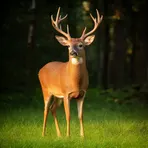
- The roe deer is well-known for its elegant movements and can often be seen in the quiet woods of Europe.
Examples
-
Luckily for wolves, the area boasts plentiful wild prey: red deer, roe deer, the wild sheep known as mouflon, and wild boars.
Academic text (1996) -
Once he even saw a kill take place of a roe deer.
Academic text (1996) -
There are owls there, and roe deer, storks, and bears.
Fiction book (1996) -
Hearing a waxwing whistle, Katya turned to see a roe deer bound up the slope and disappear over the ridge.
Fiction book (2001) -
(c) General increases in roe deer (Capreolus capreolus) distributions from 1972 to the present are associated with expansion from geographically limited introductions.
Academic text (2007) -
Reforestation has led to the recovery of remnant populations of the small roe deer and the larger red deer (a European counterpart of the North American elk).
Academic text (1996) -
While hiking in the forest, we spotted a roe deer gracefully jumping through the underbrush.
-
During early morning walks, it is common to see a roe deer grazing peacefully in the meadows.
Synonyms
 330
1.0
330
1.0
A wild animal with hooves and antlers that lives in forests and fields

A small deer that lives in woods in Europe and Asia

A small graceful deer that lives in European forests with a reddish coat and small forked antlers
How Big
- US
118
1.0

- US
1
9.1
- US
2
2.8
- UK
1
6.1
- Specialized
Surface Forms
Morphology
roe + deer
The modifier 'roe' is a rare/historical lexical item whose common sense for learners is not 'small deer' (many know 'roe' only as fish eggs or not at all), so the species name is not transparently derivable from the parts. Because the specific zoological sense of 'roe' is lexicalized and language-specific, a B1 learner who merely knows the constituent words would not reliably infer the meaning 'a small Eurasian deer'.
Etymology
Roe deer may come from an old word roe that people used for a small, quick deer, to show it was different from larger deer. That's why roe deer today means a small, graceful deer found in woods.