

white-tailed deer
 2
2.8
2
2.8

- noun
- /ˈwaɪtˌteɪld dɪr/
- US
- During the fall, many hunters prepare for the season by studying the behavior of white-tailed deer in the woods.
Examples
-
And he took me on my very first hunt, which was white tailed deer in South Carolina.
-
Wildlife enthusiasts often visit the national park to observe the majestic white-tailed deer in their natural habitat.
-
You just feed the white-tailed deer and watch the sun go down.
-
And this morning we had 7 Florida white-tailed deer in the backyard, resplendent in their winter coats.
Blog text (29) -
In the early morning, white-tailed deer trotted briskly along game trails.
Academic text (2005) -
"White-tailed deer were present but apparently rare," wrote Miron Heinselman in The Boundary Waters Wilderness Ecosystem.
Academic text (2009) -
One can find black bears, moose, beavers, and white-tailed deer, as well as hundreds of migrating birds.
Academic text (2007) -
Summer watched, mesmerized, as a trio of white-tailed deer leaped in almost perfect unison over their campsite and fled into the night.
Fiction book (1995) -
American fishers and hunters flocked to the area when the lake was ice-free to bag walleye, muskies, and white-tailed deer.
Academic text (2007) -
On the wall across from us were two framed photographs of white-tailed deer, antlered bucks poised in haughty stances over rugged, snow-blanketed country.
Fiction book (1998)
Synonyms
 5
3.7
5
3.7
A North American deer with a white underside to its tail that it shows when scared
 1
2.4
1
2.4
A North American deer with a white tail that lifts when it is scared


 1
3.0
1
3.0
A deer with white fur under its tail
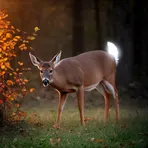
A common North American deer with a white underside to its tail

A common North American deer with white under its tail
How Big
- US
118
1.0

- US
1
9.1
- US
2
2.8
- UK
1
6.1
- Specialized
Surface Forms
Morphology
white-tailed + deer
The phrase is fully compositional: 'white-tailed' literally means 'having a white tail' (white + tail + -ed forming an adjectival descriptor) and 'deer' names the animal, so the full meaning 'a deer with a white tail' is directly derivable. This color+body-part+noun pattern is cross-linguistically common, so a B1 learner who knows 'white' and 'tail' would readily infer the MWE's meaning.
Etymology
White-tailed deer comes from the white fur under its tail. When the deer is scared it lifts the tail, showing the white as a clear 'signal', so the name tells us how the animal looks and why people notice it.