
to roar off
 1
6.3
1
6.3

- phrasal verb
- /rɔr ɔf/
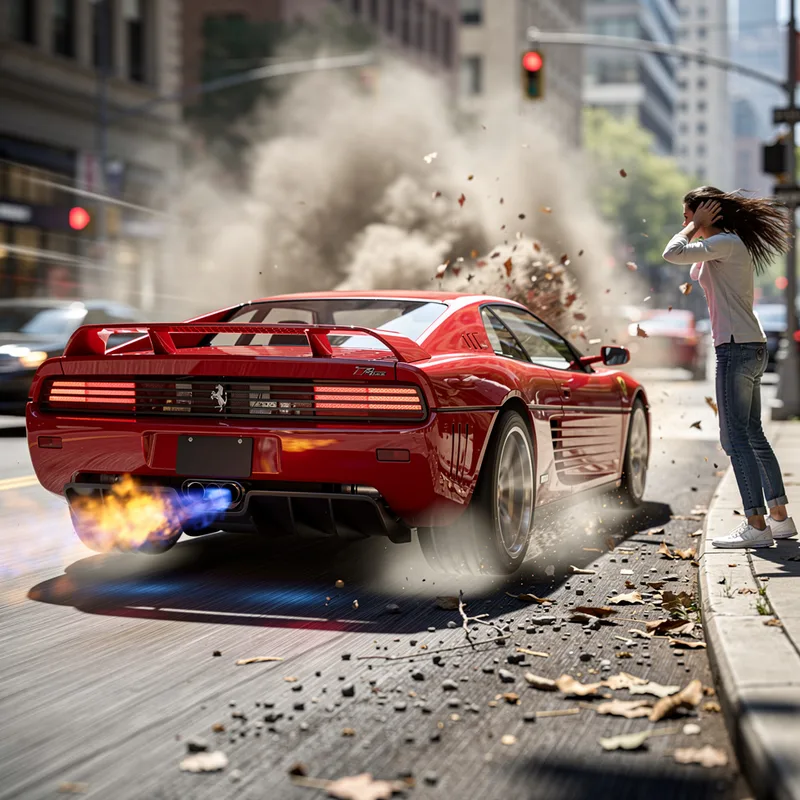
- Gates gives the shoe to Stoneface and the car roars off.
- car roared off
- motorcycle roared off
- roared off down the road
Examples
-
Behind her, she heard the van shift gears and roar off again.
Fiction book (1995) -
We fade out as the door slams and the car roars off.
Fiction book (1990) -
As he roars off down the street, we see in the building window...
Fiction book (2000) -
With a final salute, he roared off down the drive.
Fiction book (1995) -
The doors slam shut and the car immediately roars off.
Fiction book (1996) -
Then two guys roar off on a speedboat and a jet ski.
-
Duke throws the car into a skidding reverse turn and roars off.
Fiction book (1998) -
The Saipan roars off into the setting sun, hell-bent for leather.
Fiction book (1998) -
Cutter shoves the biker to the pavement, hops into the seat, revs the bike, and roars off into the night.
Fiction book (1992) -
With a final salute, he roared off down the drive, leaving a trail of dust behind.
Synonyms
 273
3.2
273
3.2
To leave a place quickly, often to travel somewhere else
 20
3.8
20
3.8
Leave suddenly because you are in a hurry
 14
2.7
14
2.7
To move or act in a noisy wild way that causes trouble
 12
7.7
12
7.7
Leave a place quickly, often in a rude way
 11
4.5
11
4.5
Leave a place quickly because you are angry
 5
4.9
5
4.9
Leave a place suddenly and quickly because you feel scared
 2
2.5
2
2.5
Leave a place quickly because you are in a hurry


 1
7.9
1
7.9
To leave a place quickly, often without saying goodbye

To run away quickly, usually because you are afraid

To walk out suddenly while showing anger
Antonyms

How Quickly

Surface Forms
Morphology
The meaning 'to leave quickly making a loud, roaring noise' is directly compositional from 'roar' (to make a loud noise) plus 'off' (away/departure), following a common English verb+particle pattern indicating movement away. This construction is predictable and cross-linguistically familiar, so a B1 learner who knows both constituents would likely infer the MWE's meaning.
Etymology
Roar off comes from the image of a car or motorcycle whose engine roars as it drives off very quickly. So it means 'to leave fast, making a loud, roaring noise'.