

ring armor
- noun
- /rɪŋ ˈɑːrmər/
- Archaic
- The knight wore ring armor beneath his tunic for added protection.
Examples
-
During the reenactment, he displayed a suit of ring armor to the audience.
-
Archaeologists discovered fragments of ring armor at the medieval burial site.
-
The knight wore ring armor during the battle.
-
In medieval times, ring armors were common among soldiers.
-
Archaeologists discovered fragments of ring armor at the medieval burial site.
-
The knight wore ring armor beneath his tunic for added protection.
-
During the reenactment, he displayed a suit of ring armor to the audience.
Synonyms
 358
3.0
358
3.0

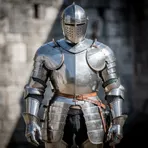
A strong metal covering worn in battle to protect the body
 8
7.2
8
7.2
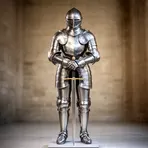
A full set of metal plates that cover the body and protect it in battle, often worn by knights
 8
9.9
8
9.9
Armor made of small metal rings joined to protect the body
 4
8.6
4
8.6
A flexible shirt of small metal rings joined together for protection

 1
9.9
1
9.9
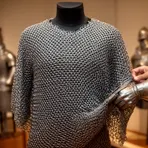
A type of flexible armor made of small metal rings linked together

A protective shirt made of small metal rings linked together, worn by knights and soldiers

A suit of metal plates worn by knights for protection in battle

A complete suit of metal plates that covers the body and protects a knight in battle
How Protective
- Specialized

- Archaic
Surface Forms
Morphology
The meaning 'armor made of interlinked rings' is directly and literally compositional from 'ring' (a circular loop or metal ring) + 'armor' (protective metal clothing). This follows the regular noun-noun compound pattern and is cross-linguistically transparent, so a B1 learner who knows both constituents would readily infer the MWE's meaning.
Etymology
Ring armor comes from how the protective suit was made long ago: it was made of many small metal rings linked together so the armor could bend like a net. That's why the name means 'flexible armor made of interlinked metal rings' used to protect people in the Middle Ages.