
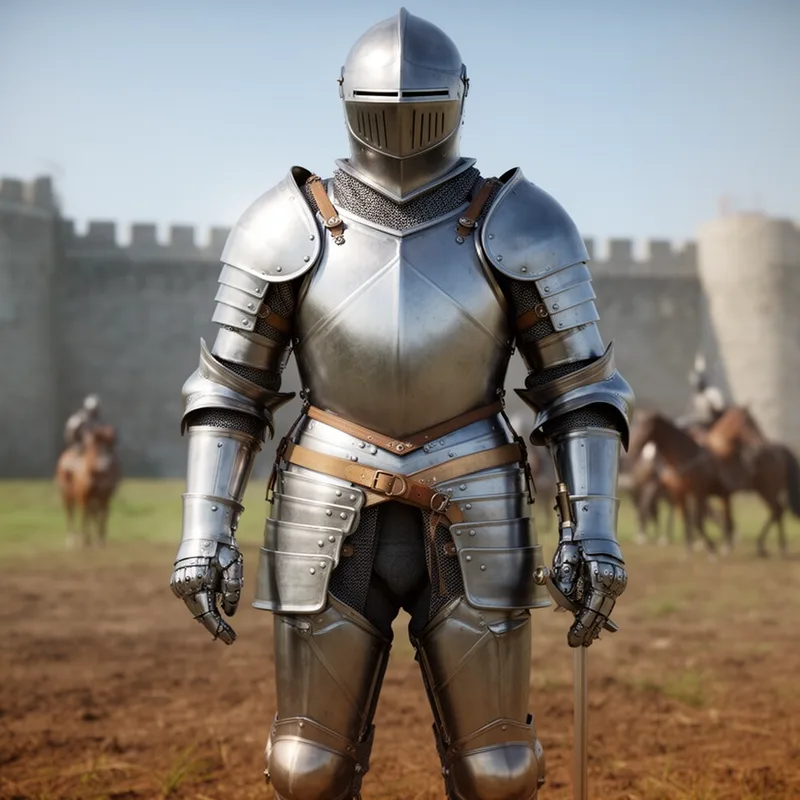
plate armor
- noun
- /pleɪt ˈɑːrmər/
- Specialized
- Don't forget to wear your plate armor during the event!
Examples
-
The knight wore a full suit of plate armor during the battle.
-
Annya watched from the keep ramparts, wearing plate armor to protect her from stray arrows.
-
Advancements in weaponry eventually made plate armor obsolete.
-
Museums often display suits of plate armor from the 15th and 16th centuries.
-
The knight donned his plate armor before riding onto the battlefield.
-
In the high period of plate armor, a complete suit of armor might weigh about 3 or 4 stone—approximately 50 pounds.
-
The triangular, short bodkin was used to penetrate plate armor.
Synonyms
 358
3.0
358
3.0

A strong metal covering worn in battle to protect the body
 31
4.1
31
4.1
Clothing made of strong material that protects the body from bullets and blows
 8
7.2
8
7.2
A full set of metal plates that cover the body and protect it in battle, often worn by knights

A complete suit of metal plates that covers the body and protects a knight in battle
Antonyms


How Protective


Surface Forms
Morphology
The meaning is directly compositional: an item of armor made from plates, which a learner who knows 'plate' (a flat sheet/panel) and 'armor' (protective metal worn by soldiers) can infer. This noun–noun compound follows regular English compounding patterns and a similar logic exists in many languages, so a B1 learner knowing the constituents would readily understand it.
Etymology
Plate armor comes from a suit made of large metal plates joined as armor to give 'protection' in battle. Picture a knight wearing overlapping metal plates that stop a sword or arrow, and you see why the phrase means heavy metal protection for a person.