
ribonuclease
- noun
- /ˌraɪboʊˈnjuːkleɪeɪs/
- Specialized
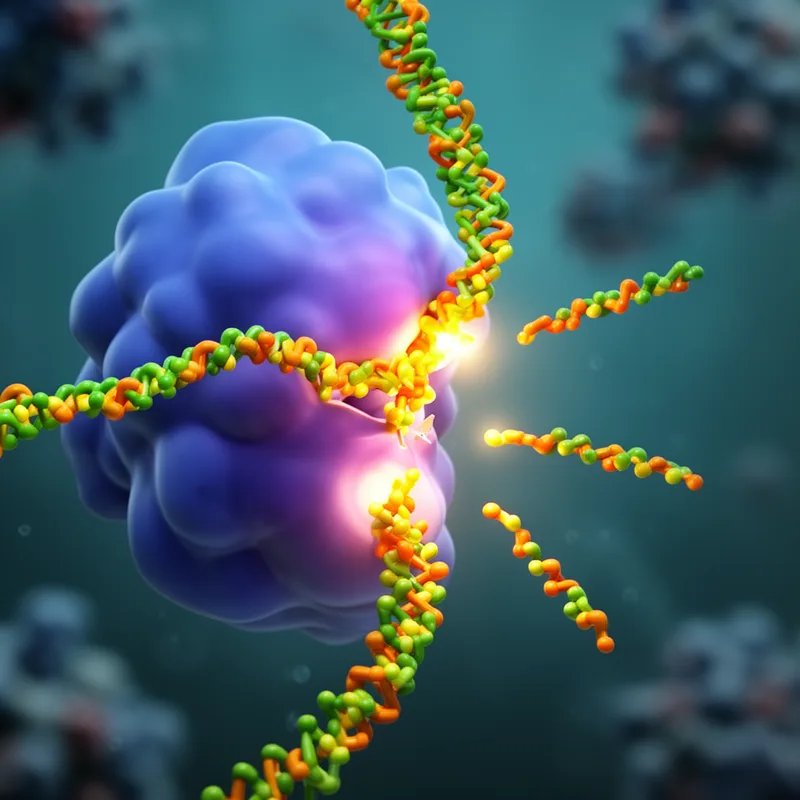
- In molecular biology, ribonuclease plays a crucial role in the degradation of RNA to regulate gene expression.
Examples
-
In the presequencing era, Woese used ribonucleases to cut the RNA into very short pieces, from which he was able to build not only a universal tree of life but also the first phylogeny of the microbial world.
Academic text (2004) -
Water and mucin, in addition to enzymes such as amylase, ribonuclease, and lipase, initiate the digestion of food by lubricating it and dissolving it into particles.
Academic text (1999) -
The experiment he did was to take native ribonuclease A, and I'm going to just sketch that.
-
It has two catalytic domains, the ribonuclease H active site and the polymerase active site.
-
The early structures for lysozyme, ribonuclease, carboxypeptidase, and chymotrypsin each provided critical insight into the mechanism of catalytic action.
Academic text (1995) -
The enzyme ribonuclease is essential for digesting RNA into smaller components during cellular processes.
-
Researchers added ribonuclease to the reaction mixture to ensure the RNA was broken down effectively.
Synonyms


 1
9.1
1
9.1
A protein that breaks the RNA in cells into small pieces
 1
8.8
1
8.8
A protein that cuts DNA or RNA into smaller pieces
A protein in cells that breaks down RNA, the cell's genetic material
Surface Forms
Morphology
Etymology
Ribonuclease is built from parts you can recognise: ribo- refers to 'ribose', the sugar in RNA, and the ending -ase marks an enzyme, as in amylase. The middle nuclease links to nucleus ('kernel' or 'center'), so a ribonuclease is an enzyme that 'cuts' or breaks down RNA, which explains its modern meaning.