

reverse Polish notation
- noun
- /rɪˈvɜrs ˈpoʊlɪʃ noʊˈteɪʃən/
- Specialized
 :
notación polaca inversa
:
notación polaca inversa
- Calculators using reverse Polish notation require users to enter numbers first, followed by the operation.
Examples
-
Because reverse Polish notation eliminates parentheses, it can simplify the process of programming calculators.
-
When learning computer science, students often encounter reverse Polish notation as an example of expression evaluation.
-
I learned about reverse Polish notation in my math class.
-
Using reverse Polish notation can simplify complex calculations.
-
Calculators using reverse Polish notation require users to enter numbers first, followed by the operation.
-
Because reverse Polish notation eliminates parentheses, it can simplify the process of programming calculators.
-
When learning computer science, students often encounter reverse Polish notation as an example of expression evaluation.
Synonyms
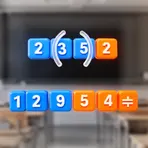
A way of writing math expressions without parentheses where each sign comes after the numbers

A way of writing math where operators come after numbers
A way of writing math where operation signs come after numbers so parentheses are not needed
Surface Forms
Morphology
Although the words 'reverse' and 'notation' hint at a reversed form of some Polish-origin notation, the specific operational property (that operators follow operands so parentheses are unnecessary) is a technical, language-specific convention not derivable from the constituent meanings; 'Polish' only indicates origin and gives no clue to the syntactic ordering. A B1 learner who knows the individual words would not reliably infer this precise mathematical meaning without prior exposure.
Etymology
Reverse Polish notation is named after a Polish thinker, Jan Łukasiewicz, and the word 'reverse' shows the order is turned around so the operation (for example + or ×) comes after the numbers. That's why you can write expressions without 'parentheses', because the order of calculation is clear.

