
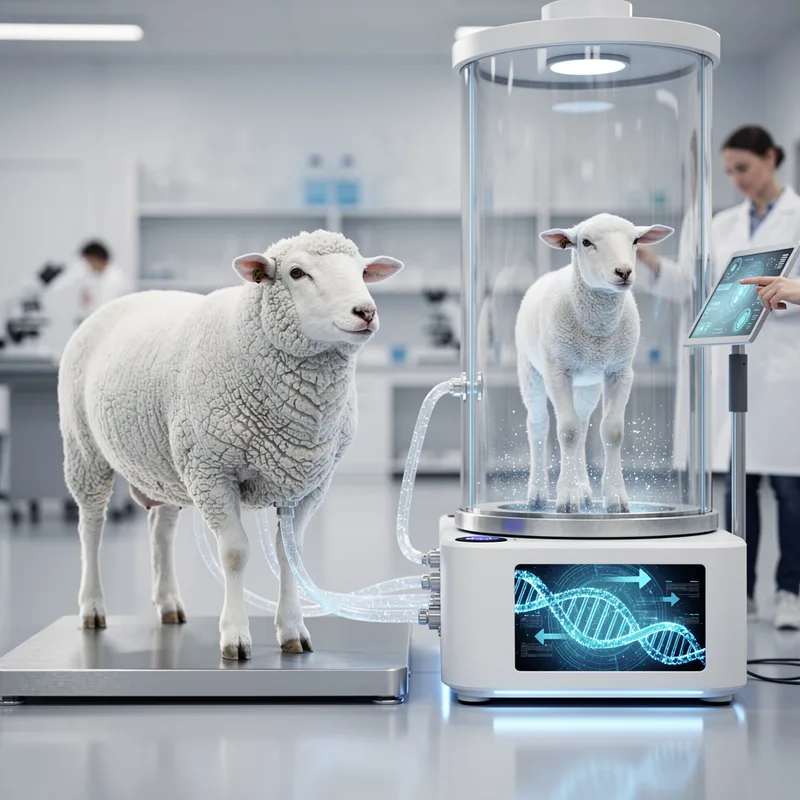
reproductive cloning
 1
6.5
1
6.5

- noun
- /ˌriːprəˈdʌktɪv ˈkloʊnɪŋ/
- Specialized
- Whereas West envisions remarkable advances in life extension and the treatment of disease, Kass worries about the potential of genetic engineering to usher in a brave new world in which reproductive cloning will rob humanity of its dignity.
- human reproductive cloning
- reproductive cloning ban
Examples
-
Human reproductive cloning, after all, "forces us to rethink in the most basic way the meaning of individuality, personal identity
Academic text (2017) -
To begin with the prospect of complete genetic duplication, or human reproductive cloning, as contrasted with therapeutic cloning to produce master cells, what is it that people fear in human cloning?
Academic text (2003) -
There is not a group of "mad scientists" creating monsters in private labs—though the three scientists who are insisting on their right to engage in reproductive cloning do demonstrate the presence of extremists even among scientists.
Academic text (2001) -
Researchers are exploring the implications of reproductive cloning for endangered species conservation.
-
Many scientists believe reproductive cloning could help increase genetic diversity in agriculture.
-
The ethical debate surrounding reproductive cloning continues to spark discussions in bioethics.
Synonyms
 85
4.0
85
4.0
To make an exact copy of a gene, cell, or living thing in a lab
 6
4.0
6
4.0
A copy of something made to look exactly like the original
Surface Forms
Morphology
The overall meaning is directly compositional: 'reproductive' (relating to generating offspring) modifies 'cloning' (producing identical biological copies), so the phrase clearly denotes creating a genetically identical new individual. This construction follows regular adjective+noun compounding and has close equivalents in other languages, so a B1 learner who knows both words should be able to infer the MWE meaning.
Etymology
Reproductive cloning joins reproductive (making a new animal or person) and cloning (making a copy). The image is of making a living copy that can be born and grow, so the term means 'creating a genetically identical new individual'.