
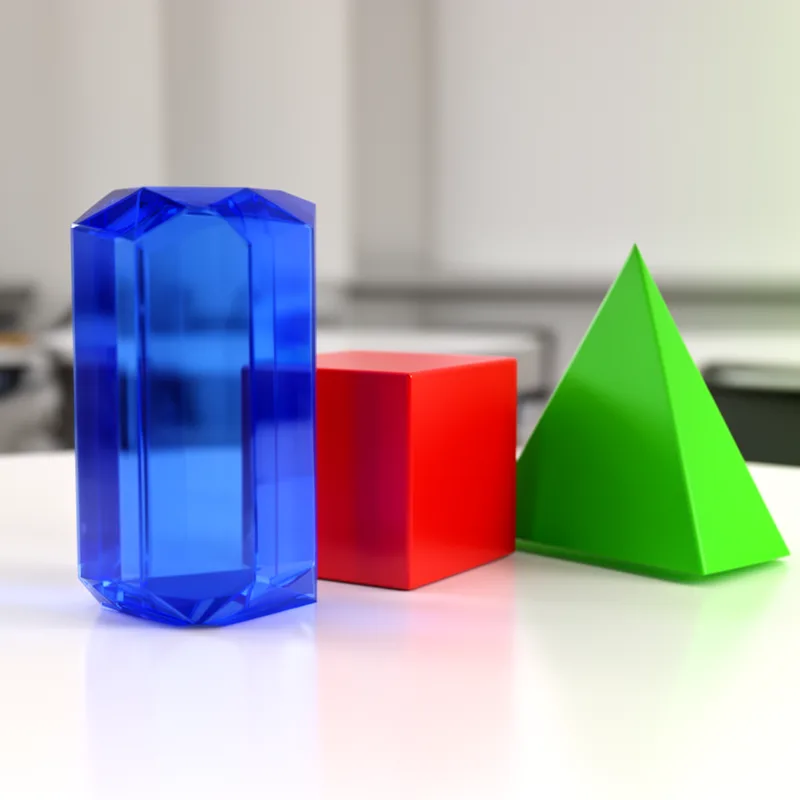
regular prism
- noun
- /ˈrɛɡjələr ˈprɪzəm/
- Specialized
- The volume of a regular prism can be calculated by multiplying the area of its base by its height.
Examples
-
A cube is a special case of a regular prism with square bases.
-
In geometry class, students learned to identify different types of regular prisms and calculate their surface areas.
-
A regular prism has identical bases and rectangular sides.
-
The geometry class studied the properties of a regular prism.
-
A cube is a special case of a regular prism with square bases.
-
In geometry class, students learned to identify different types of regular prisms and calculate their surface areas.
-
The volume of a regular prism can be calculated by multiplying the area of its base by its height.
Surface Forms
Morphology
The phrase is a simple adjective + noun composition: 'regular' describes the type of 'prism', so a learner who knows both words can infer it means a prism whose bases are regular polygons. This follows normal English modification patterns and has direct equivalents in many languages, making the meaning immediately predictable for a B1 learner.
Etymology
Regular prism comes from a simple picture: a prism is a solid with the same shape on both ends, and regular means the end shapes are neat polygons with all sides the same. So imagining two identical regular polygons joined by flat side faces explains why the term means 'a prism whose bases are regular polygons and whose sides join the bases'.

