
regelation
- noun
- /ˌriːɡəˈleɪʃən/
- Specialized
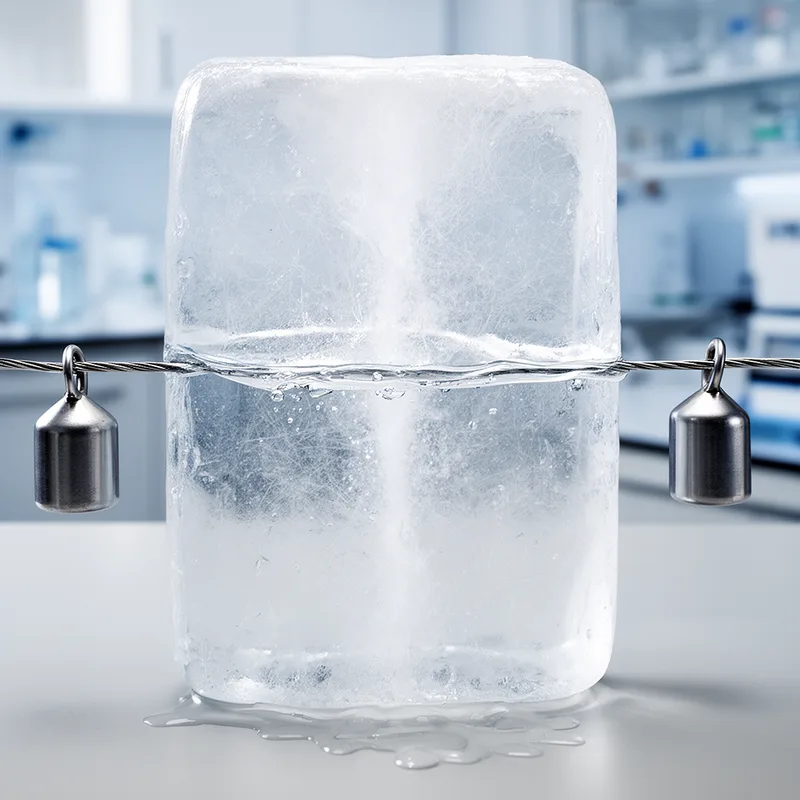
- When pressure is applied, ice undergoes regelation, melting and then refreezing once the pressure is released.
Examples
-
In a discourse given at the Royal Institution on 7 June 1850, he devoted most of his remarks to elegant experiments he had conducted on regelation, the freezing together of two ice cubes when they come into contact.
Academic text (2005) -
"If brought into the slightest contact, regelation ensued, the blocks adhered, and they remained adherent notwithstanding the force tending to pull them apart."
Academic text (2005) -
In 1963, J. W. Telford and J. S. Turner carried out a series of regelation experiments, each at a different temperature, in which a wire under pressure slowly migrates through ice.
Academic text (2005) -
Shortly after Faraday's published account appeared in 1859, James Thomson took the position that the regelation Faraday observed was due to pressure on the ice cubes.
Academic text (2005) -
The phenomenon of regelation explains how ice can fuse together under weight, then hold its shape when the weight is lifted.
-
During his experiments, he demonstrated that regelation occurs when two ice masses merge due to the pressure exerted on them.
Surface Forms
Morphology
Etymology
Regelation starts with re- meaning 'again' and the part gel meaning 'to freeze'. So Regelation is like 'freezing again', which explains why ice melts under pressure and then freezes again when the pressure is removed.

