

refractive index
 1
6.1
1
6.1

- noun
- /rɪˈfræktɪv ˈɪndɛks/
- Specialized
- In glasses, the losses within this optic window are dominated by scattering from static fluctuations of the refractive index and by absorption by impurities and structural defects.
- refractive index of glass
- refractive index of a medium
- refractive index changes
Loading YouTube…
Watch on YouTubeAnd that's because of its high refractive index and its size.
- And that's because of its high refractive index and its size.
Examples
-
Like many things in physics, refractive index isn't as simple as we learned in high school.
Academic text (2001) -
The linear optical properties of a material are determined by its refractive index.
Academic text (2012) -
So N here is the refractive index of this cell.
-
And that's because of its high refractive index and its size.
-
Often, we can describe media by their refractive indices.
Academic text (1999) -
Anything transparent becomes practically invisible if put into any media of the same refractive index.
-
So, for example, glass has a refractive index that varies with wavelength.
-
Even when passing through natural materials with the highest refractive indexes, light can only bend so far.
-
"SPR uses light reflected off thin metal films," Medina explains. "Toxin molecules in the sample bind to the sensor surface, and the refractive index at the surface changes."
Academic text (2005) -
The refractive index of water is approximately 1.33, indicating how much it slows down light.
Synonyms


 1
6.9
1
6.9
A number showing how much light slows in a material compared to empty space
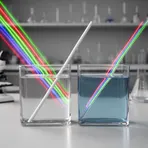
The amount a material bends light and other waves

The amount a material bends light when the light passes through it, like water or glass
Surface Forms
Morphology
The phrase is compositionally built: 'refractive' relates to bending/slowing of light and 'index' denotes a numeric indicator, so a learner who knows both words can infer it is a number that quantifies refraction. This construction is also cross-linguistically common (e.g. Spanish índice de refracción, French indice de réfraction), supporting its predictability for learners.
Etymology
Refractive index comes from the idea of 'refraction', which is light bending when it goes into something like water. For example, a straw looks bent in a glass. The word refractive points to that bending and index means a number that compares how fast light moves in empty space and in the material, so the term tells how much the material slows and bends light.