
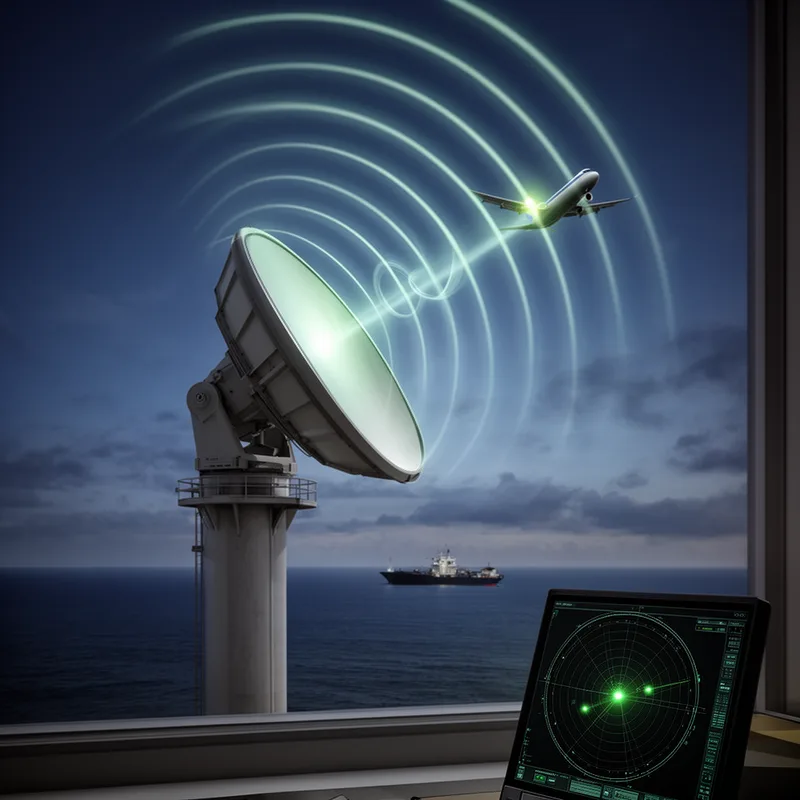
radio detection and ranging
- noun
- /ˈreɪdioʊ dɪˈtɛkʃən ənd ˈreɪndʒɪŋ/
- Specialized
- Early airport security depended heavily on advances in radio detection and ranging technology.
Examples
-
Many ships rely on radio detection and ranging for navigation.
-
Meteorologists rely on radio detection and ranging to monitor storms and predict weather patterns.
-
The development of radio detection and ranging transformed military and civilian navigation systems.
-
The radio detection and ranging system is crucial for aviation safety.
-
The military uses radio detection and ranging to track enemy aircraft during operations.
-
Many modern ships are equipped with radio detection and ranging systems to navigate safely in busy waters.
-
Pilots rely on radio detection and ranging technology to ensure safe landings at airports.
Synonyms
 367
4.1
367
4.1

A machine that uses radio waves to find objects and show their distance and speed
 189
3.5
189
3.5
A device that senses things like metal, movement, or radioactivity


 1
8.4
1
8.4
A system that uses radio waves to find distant objects by measuring echoes

A system that sends short bursts of microwaves to find how far away objects are
How Far
- Specialized

- Specialized
Surface Forms
Morphology
radio + detection + and + range
The phrase is literally compositional: 'radio' (using radio waves) + 'detection' (discovering/locating) + 'ranging' (measuring distance), so a learner who knows those constituent meanings can infer it denotes a system that detects and measures distance using radio waves. This technical naming follows transparent, cross-linguistic compositional patterns (and appears as the acronym RADAR), making the meaning accessible to B1 learners.
Etymology
Radio detection and ranging names exactly what the system does: it sends out radio waves and listens for an 'echo' to do the detection and to measure 'distance' in the ranging. Imagine shouting in a dark room and using the echo to find how far away the walls are — that image shows why the phrase means a system that finds and tells how far away objects are.