

quartz glass


 1
6.8
1
6.8
- noun
- /kwɔrts ɡlæs/
- Specialized
 :
vidrio de cuarzo
:
vidrio de cuarzo
- Since most materials do not efficiently transmit ultraviolet light, a special quartz glass is used to encase the lamps.
Examples
-
Would the quartz glass be susceptible to flow, and if so, over what timeframe would the information degrade?
Blog text (23) -
A woman holds up Japanese electronics giant Hitachi's new quartz glass plate technology, which can be used to store data indefinitely, in Tokyo on September 24.
Blog text (23) -
Would the quartz glass be susceptible?
Blog text (23) -
The nail lodges in the thick quartz glass.
Fiction book (1997) -
The quartz glass allows about 93% of emitted ultraviolet light to pass into the water (32).
Academic text (1994) -
Hitachi's new technology stores data in binary form by creating dots inside a thin sheet of quartz glass, which can be read with an ordinary optical microscope.
Blog text (23) -
Hitachi's new technology stores data in binary form by creating dots inside a thin sheet of quartz glass, which can be read with an ordinary optical microscope.
Blog text (23) -
The laboratory used a quartz glass container to hold the reactive chemicals safely.
-
For her experiment, she opted for a quartz glass lens to ensure minimal distortion.
-
Because of its durability, quartz glass is often chosen for high-temperature applications.
Synonyms
 2
5.3
2
5.3
A clear glass that resists heat and chemicals used for lab tools and scientific instruments
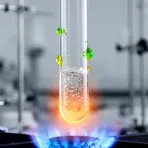
A clear glass made mostly of silica that resists heat and chemicals
How Heat Resistant

Surface Forms
Morphology
The phrase is a straightforward noun–noun compound: 'quartz' (a form of silica) + 'glass' (the material), so its meaning — glass made from quartz/pure silica — is directly derivable from the constituents. Although somewhat technical, the compositional pattern is regular and cross-linguistically common, so a B1 learner who knows both words would understand it.
Etymology
Quartz glass comes from making glass out of nearly pure quartz, a hard mineral like sand. Because this glass stays clear and does not change when it meets strong 'heat' or 'chemicals', the name now means a special, very heat-resistant glass used in labs and optical equipment.