
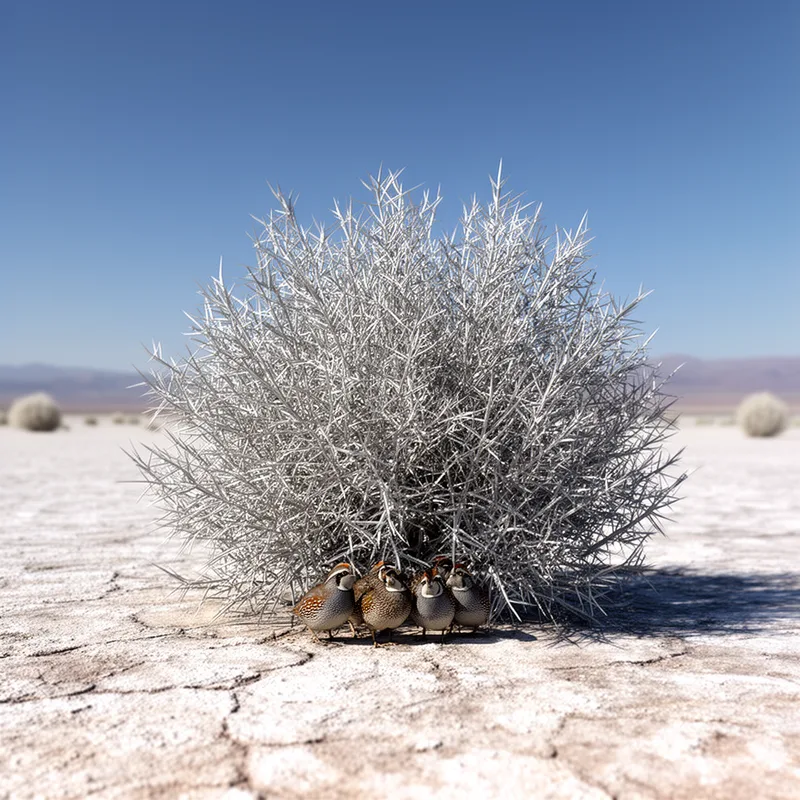
quail brush
- noun
- /ˈkwāl ˌbrəsh/
- US
- The quail brush thrives in arid, alkaline soils where few other plants can survive.
Examples
-
Botanists are studying the adaptation mechanisms of quail brush to harsh desert climates.
-
After hiking for miles, we finally spotted a covey of quail hiding beneath a quail brush.
-
Look at that beautiful quail brush over there!
-
The quail brush grows abundantly in the desert.
-
The quail brush provides shelter for various desert animals during the hot day.
-
In spring, the quail brush blooms, adding color to the barren landscape.
-
We learned that the quail brush is vital for supporting wildlife in the southwestern ecosystem.
Synonyms


 1
9.9
A spiny shrub with silvery leaves that grows on dry, often salty plains

A thorny bush with silver leaves that grows in dry salty ground

A spiny shrub with silvery leaves that grows on dry, salty plains
Surface Forms
Morphology
The noun–noun compound combines 'quail' (a bird) with 'brush' (a thicket or low shrubs) to denote a type of shrub associated with quails. This animal+habitat/plant compositional pattern is straightforward and cross-linguistically common, so a B1 learner who knows both constituents can reasonably infer it refers to a kind of shrub even without knowing the specific species.
Etymology
Quail brush: The name quail brush comes from small birds called quail hiding in low, spiky brush for 'shelter'. That's why the term now refers to a tough, spiny shrub that grows on dry plains.