

Atriplex lentiformis
- noun
- Specialized
- The Atriplex lentiformis thrives in the saline soils of desert valleys.
Examples
-
Researchers studied the water retention abilities of Atriplex lentiformis in southwestern ecosystems.
-
Farmers often use Atriplex lentiformis as forage for livestock in arid regions.
-
The Atriplex lentiformis thrives in arid conditions.
-
Can you identify the Atriplex lentiformis in this area?
-
Farmers often use Atriplex lentiformis as forage for livestock in arid regions.
-
The Atriplex lentiformis thrives in the saline soils of desert valleys.
-
Researchers studied the water retention abilities of Atriplex lentiformis in southwestern ecosystems.
Synonyms

A spiny shrub with silvery leaves that grows on dry, often salty plains

A spiny shrub with silvery leaves that grows on dry, salty plains
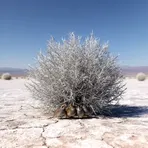
A spiny shrub with silvery leaves that grows on dry alkaline plains
Surface Forms
Morphology
Atriplex + lentiformis
This is a scientific binomial: 'Atriplex' clearly signals a plant genus so a learner who knows that constituent can infer it names a species of Atriplex, but the second element 'lentiformis' is a Latin adjective (not given here) and is unlikely to be known by a B1 learner. Thus the term gives partial, surface-level information (that it is a plant species) but the specific descriptive meaning (e.g., 'lens-shaped') is not transparently recoverable for most learners.
Etymology
Atriplex lentiformis comes from old Latin words: Atriplex names a group of 'saltbush' plants and lentiformis means 'lentil-shaped', a picture of its round, silvery leaves. So the name describes a shrub that grows in salty soils and has round, lentil-like leaves.

