

to push one's way past
- phrasal verb
- Informal
- She pushed her way past the crowd to catch her train in time.
Examples
-
We had to push our way past the long line of people waiting outside the store.
-
The paramedics pushed their way past the reporters to reach the injured.
-
It's rude to push your way past people!
-
To board the bus, he pushed his way past the other passengers who were blocking the door.
-
The fireman pushed his way past the onlookers to reach the burning building.
-
She had to push her way past the dense crowd at the concert to get to her friend.
Synonyms

 ∞
1.0
∞
1.0

To move something away from you using force, often with your hands
 528
2.7
528
2.7
Push someone or something roughly and quickly
 141
2.7
141
2.7
Move close together and push forward in a crowd
 80
2.1
80
2.1
Pass from one point to another during a journey or process
 43
3.7
43
3.7
To move suddenly through a barrier, as light or a person
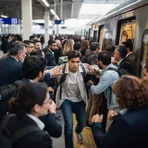 6
3.6
6
3.6
To move ahead by pushing people or things out of the way
 6
2.1
6
2.1
Move something or someone out of the way with your hands
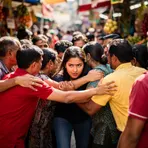 4
3.9
4
3.9
Move forward by getting past people or things blocking the way
 1
4.8
1
4.8
A push or bump in a crowd to get past someone


 1
7.4
1
7.4
To move forward with difficulty through people or things with effort
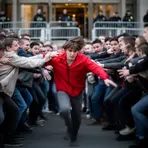
Move quickly through a crowd while pushing people aside
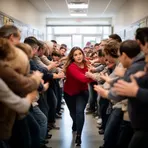
To push forward through a crowd to get ahead

To move forward through a place despite problems
Antonyms


How Forceful
- Informal
42
6.0

- Informal
528
2.7
4
3.0
1
7.9
Surface Forms
Morphology
The meaning is directly derivable from 'push' (apply force) combined with 'one's way' (make a path or progress) and 'past' (by/through), so a learner who knows the constituents can infer 'forcefully move through or by people/obstacles'. This is a compositional motion/passage construction common across languages rather than an idiomatic shift, making it immediately comprehensible to a B1 learner.
Etymology
The phrasal verb push one's way past creates the image of someone using their hands and shoulders to push forward and make a way through a crowd to get past people. That's why it means 'to force through a group or obstacle'.