

public easement
- noun
- /ˈpʌblɪk ˈiːzmənt/
- Specialized
- Under the Coastal Act, public easements must be managed by local governments or by components of the public such as nonprofit agencies or private citizens acting as land trusts (Buxton 1997).
Examples
-
She showed the officers that 43 of the 108 houses built along the sand had public easements tied to their property.
Academic text (2005) -
The city council granted a public easement for pedestrians to cross the park safely.
-
That is, for years the commission required as a condition for approval of new property development and redevelopment of existing property that the owner dedicate a certain amount of the property for either a horizontal (parallel to the shore) or vertical (perpendicular to the shore) public easement.
Academic text (2005) -
Residents are allowed to use the public easement to access the beach from the road.
-
A public easement enables local citizens to walk along the waterfront without obstruction.
Synonyms

 9
9.5
9
9.5

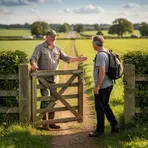
A legal right to use someone else's land for a specific purpose, like a path
 4
4.9
4
4.9
Permission to pass through someone else's land
Surface Forms
Morphology
The phrase is a straightforward modifier + noun composition: 'public' (accessible to everyone) applied to the legal noun 'easement' yields an easement that the general public may use. This compositional pattern is direct and cross-linguistically common, so a B1 learner who knows both constituent meanings can infer the MWE meaning.
Etymology
Public easement comes from the idea that land is made easier to use for everyone: public means for everyone and easement comes from old words for 'ease' or 'making passage easy'. That's why a public easement means a right that lets people use part of private land, like a path or river access.