
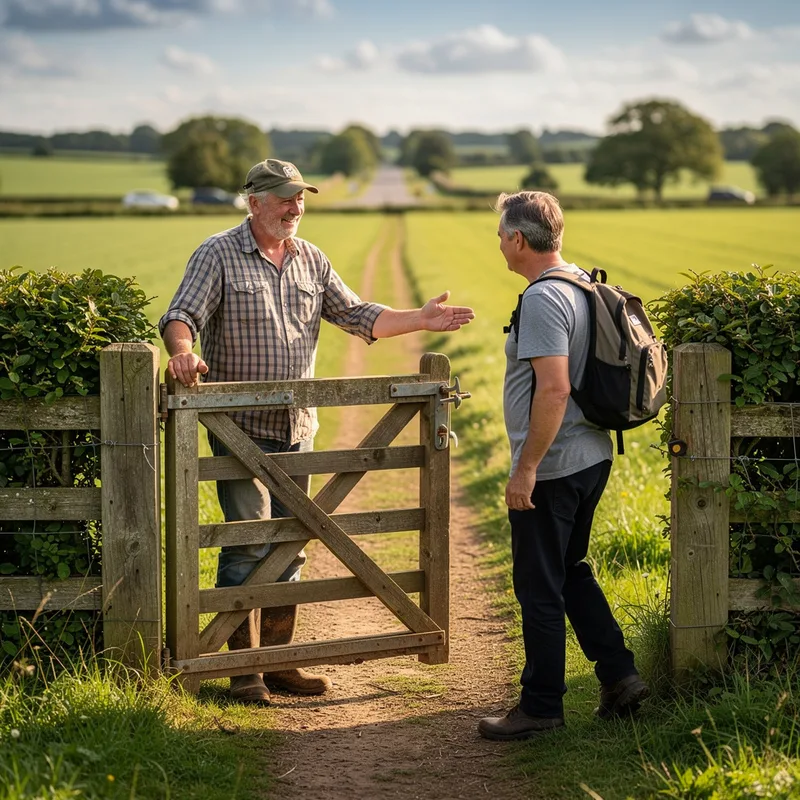
right of way
 4
4.9
4
4.9

- noun
- /ˈraɪt əv weɪ/
- Formal
- To build the new road, they had to negotiate the right of way with several property owners.
- railroad right of way
- public right of way
- land for right of way
Examples
-
The issue is whether car owners should have more rights or privileges to use the road right-of-way as car storage than car users.
Blog text (16) -
I went up to the courthouse and looked at the right-of-way documents for the rail bed.
Fiction book (2001) -
Your acreage here is on the proposed right of way.
Fiction book (2001) -
A sign proclaimed this a right of way.
Fiction book (2001) -
The flower bed is private property, and no one was encroaching on the public right of way.
Blog text (9) -
In the case of the transcontinental rail, the government gave the right of way in return for building the rail.
Blog text (25) -
Ferries compete well because the right of way is free and docks are plentiful.
Blog text (19) -
Last July, the city changed the rules governing food vendors in city rights-of-way in an attempt to make it easier for vendors to set up shop outside.
Blog text (1) -
Doesn't the City of Seattle have to cede right-of-way underneath its own property to the state as well?
Blog text (1) -
Additionally, the Public Works Department prunes and maintains trees located in the public right-of-way planting strip between the sidewalk and street in newer neighborhoods in Davidson.
Blog text (16)
Surface Forms
Morphology
The meaning 'legal right to pass along a route' is directly derivable from combining 'right' (a legal entitlement) with 'way' (a route) joined by 'of' to indicate a relation, so a B1 learner who knows the constituents will likely infer permission to use or precedence on that path. This construction is cross-linguistically common (e.g., Spanish 'derecho de paso', French 'droit de passage') and appears transparently in both property and traffic contexts.
Etymology
Right of way comes from people allowing others to cross their land: if a neighbor could use a path across a field, they had the right to the way. That's why 'right of way' means the legal right to pass along someone else's property.