
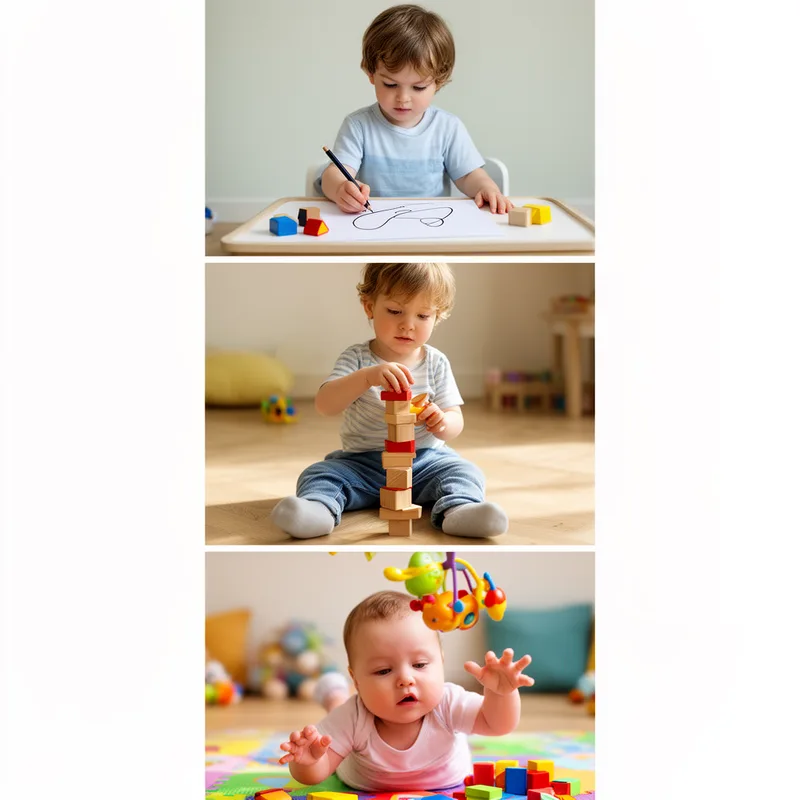
psychomotor development
- noun
- /ˌsaɪkoʊˈmoʊtər dɪˈvɛləpmənt/
- Specialized
- During preschool, children engage in activities designed to promote their psychomotor development, such as climbing and jumping.
- psychomotor development of children
- 36-Month psychomotor development
Examples
-
The Bayley Scales of Infant Intelligence – Revised (BSID-II) were used to assess cognitive and psychomotor development at age 36 months.
Academic text (2011) -
Music educators should also be aware of the cognitive and psychomotor development of children in order to properly sequence learning objectives.
Academic text (1991) -
Readiness is an issue that parents should be aware of when dealing with the psychomotor development of young children.
Academic text (1993) -
Four measures were utilized to assess affective and psychomotor development.
Academic text (2007) -
However, we found that the association between neighborhood poverty and psychomotor development was independent of measured exposure to chlorpyrifos and secondhand smoke.
Academic text (2011) -
Thus, it was possible to determine if sociomoral and/or psychomotor development continued to improve, declined, or remained the same after the intervention.
Academic text (2007) -
The purpose of this study was to implement and evaluate a curricular model designed to enhance sociomoral and psychomotor development in physical education.
Academic text (2007) -
The questions on the second survey concerned diagnoses and treatments, and they solicited further data on each child's psychomotor development.
Academic text (2002) -
Currently, the primary focus of physical education activity classes is centered on behavioral or psychomotor development (Harrison, Blakemore, Buck, & Pellett, 1996).
Academic text (2001) -
Parents play a vital role in supporting the psychomotor development of their toddlers through play activities.
Surface Forms
Morphology
The phrase is a straightforward composition of 'psychomotor' (relating mental processes and physical actions) + 'development' (growth/acquisition), so the meaning — the development of coordinated mental and motor skills — follows directly from its parts. Although somewhat technical in register, the semantic combination is predictable and cross-linguistically accessible, so a B1 learner who knows both constituents would be able to infer the meaning.
Etymology
Psychomotor development is made from the parts psycho meaning 'mind' and motor meaning 'movement'. Think of a child learning to reach, walk and hold things as their 'mind' and 'movement' grow together. That's why the phrase means learning skills that need both thinking and body control.

