

protist
 1
8.6
1
8.6

- noun
- /ˈproʊtɪst/
- Specialized
- Much larger than bacteria, single-celled protists are distinguished by a more complex metabolism and DNA that is concentrated in a nucleus.
Examples
-
Yup, the protist nourishes the clam in environments that are less than ideal for thriving.
-
Two protists of the same species come together, their cell walls dissolve at the boundary, and they join temporarily as one unit.
Academic text (2002) -
Your temperature, for example, even protists will seek places of the right temperature.
-
And in turn, the protist is sheltered within the clam's shell.
-
The data set he's generated so far, collected from previous research conducted by others, includes plants, animals, fungi, and a couple of protists.
Academic text (2007) -
Photosynthesis had evolved in a few Monerans, but the three nutritional modes became well established only after the first eukaryotic protists evolved through endosymbiosis.
Academic text (2012) -
Many protists live in freshwater environments, where they play crucial ecological roles.
-
Microscopic protists, such as amoebas and diatoms, can be found in ocean waters.
-
Researchers study protists to better understand the evolution of eukaryotic organisms.
Synonyms
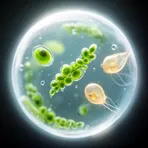
Small living things made of one cell or a few cells, like algae, often found in water

A single-celled organism like algae that is not an animal or plant
Surface Forms
Morphology
protist = prot + ist
Although historically built from the combining form prot- ('first') + -ist, the modern taxonomic meaning 'a diverse group of mostly unicellular eukaryotes' is a specialized biological category not directly inferable from the morphemes by an average learner.
Etymology
Protist comes from the prefix proto- meaning 'first', the same part you see in prototype. Scientists used this name for early or simple life forms, so a protist is often a mostly single-celled organism that is not an animal, plant, or fungus.