

protective embankment
- noun
- Specialized
- The soldiers took cover behind the protective embankment during the assault.
Examples
-
Many ancient forts had protective embankments to deter invaders.
-
Archaeologists uncovered the remains of a medieval protective embankment near the site.
-
A protective embankment was quickly constructed to strengthen the old fortress.
-
The castle was surrounded by a protective embankment.
-
A protective embankment was quickly constructed to strengthen the old fortress.
-
The soldiers took cover behind the protective embankment during the assault.
-
Many ancient forts had protective embankments to deter invaders.
Synonyms
 22
5.9
22
5.9

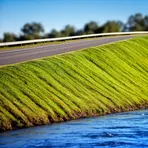
A raised bank of earth or stone that keeps water away and supports a road
 12
8.8
12
8.8
A wide wall of earth or stone that protects a castle
 11
8.6
11
8.6
A strong wall built to protect a place like a city or ship

A steep man-made slope in front of a fort to stop attackers
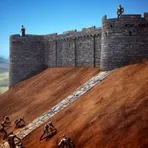
A steep man-made slope in front of a fort's walls that makes attack harder

A steep built slope or wall in front of a fort to stop attackers

A raised bank of earth built to support a road or defend a place

A gentle open slope in front of a fort that exposes attackers to defenders' fire
Antonyms


How Defensive

Surface Forms
Morphology
The meaning is directly and compositionally derived from 'protective' (serving to protect) modifying 'embankment' (an earth or stone structure), so a learner who knows both constituents can infer it is an embankment used for protection. The ADJ+NOUN pattern is common across languages and contexts (flood control or defence), making the phrase predictable and transparent to a B1 learner.
Etymology
Protective embankment comes from the image of a steep bank of earth built in front of a fort. Soldiers hid behind the embankment to stop or slow attackers, so it means a built barrier 'to protect' a place.