
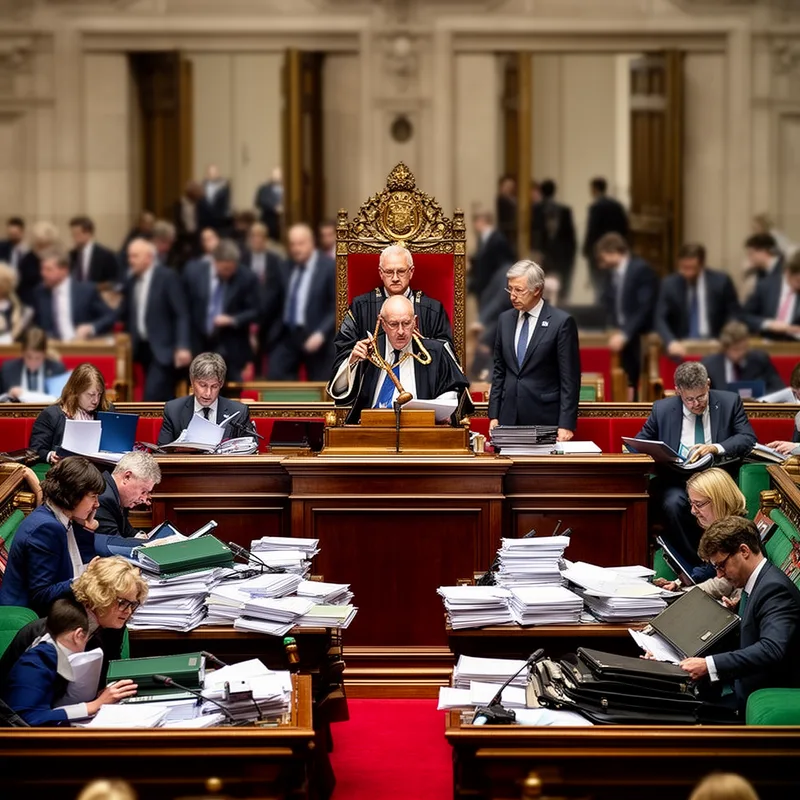
to prorogue


 1
9.9
1
9.9
- verb
- /prəˈroʊɡ/
- UK
- After intense discussions, they agreed to prorogue the current session to allow for further review.
- prorogue Parliament
Examples
-
Bill C-94 did not complete its passage through the House of Commons when Parliament was prorogued at the end of January 1996.
Academic text (2000) -
The Commission was also for proroguing this present Parliament.
-
The assembly was prorogued two days later, and direct rule was resumed.
Academic text (2001) -
Having been prorogued, each House does not conduct any further business until the Governor General issues another proclamation for a new session.
Blog text (31) -
The Prime Minister decided to prorogue Parliament until the next session begins.
-
The Governor General officially prorogued the legislative assembly after the debate concluded.
Synonyms
 234
3.4
234
3.4
To delay something until a later time because of a problem
 113
2.9
113
2.9
Delay something until a later time
 81
5.3
81
5.3
Stop a meeting for a short time to continue later
 15
5.5
15
5.5
To delay something until a later time
 15
4.8
15
4.8
To stop a meeting, court, or session for a short time
 1
4.6
1
4.6
To keep something for use or sale after its planned time
Antonyms

Surface Forms
Etymology
Prorogue comes from Latin parts pro- and rogare, with rogare meaning 'to ask' and pro- giving a sense of 'forward'. So to prorogue Parliament is like 'asking' to push its meeting forward, which is why the word means to formally delay or end a session until later.