

profoundly deaf
 2
3.9
2
3.9

- adjective
- /prəˈfaʊndli dɛf/
- Specialized
 :
sordo profundo
:
sordo profundo
- She was left profoundly deaf in both ears.
- profoundly deaf infants
Examples
-
Felicity has neurofibromatosis, which has as a result, left her profoundly deaf and with low vision.
-
Cochlear implants (CIs) have been designed to assist individuals who are severely to profoundly deaf with verbal communication.
Academic text (2010) -
I very suddenly and unexpectedly found myself profoundly deaf late in 2007.
Blog text (9) -
Many children who are deaf-blind are not totally blind and profoundly deaf.
Academic text (1996) -
For example, one profoundly deaf child demonstrated his interest by seeking out and even playing drums and bells prior to the music lesson.
Academic text (2009) -
People with Type I are born profoundly deaf with RP and have no vestibular function.
Academic text (1997) -
The doctor at the institute confirmed that Louis was profoundly deaf.
-
By the time she was 11, a doctor diagnosed her as being profoundly deaf.
-
What made the diagnosis even scarier was that Kennedy was born profoundly deaf.
Synonyms
 212
1.0
212
1.0
Not able to hear, completely or partly
 2
8.6
2
8.6
Unable to hear anything at all
 1
6.7
1
6.7
Unable to hear anything at all

Not able to hear anything
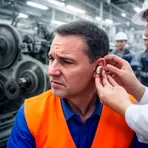
No longer able to hear because of loud noise or injury
How Deaf

Surface Forms
Morphology
This is a compositional intensifier + adjective construction: 'profoundly' (very/completely) modifies 'deaf' (unable to hear), so the meaning 'completely unable to hear' follows directly from the parts. The pattern of an adverb strengthening an adjective is common cross-linguistically and thus readily understandable to a B1 learner who knows both constituents.
Etymology
The adjective profoundly deaf combines profoundly ('very deep') and deaf ('unable to hear'), so imagine sound falling into a deep, silent well where nothing comes back. That's why it means 'completely unable to hear'.