
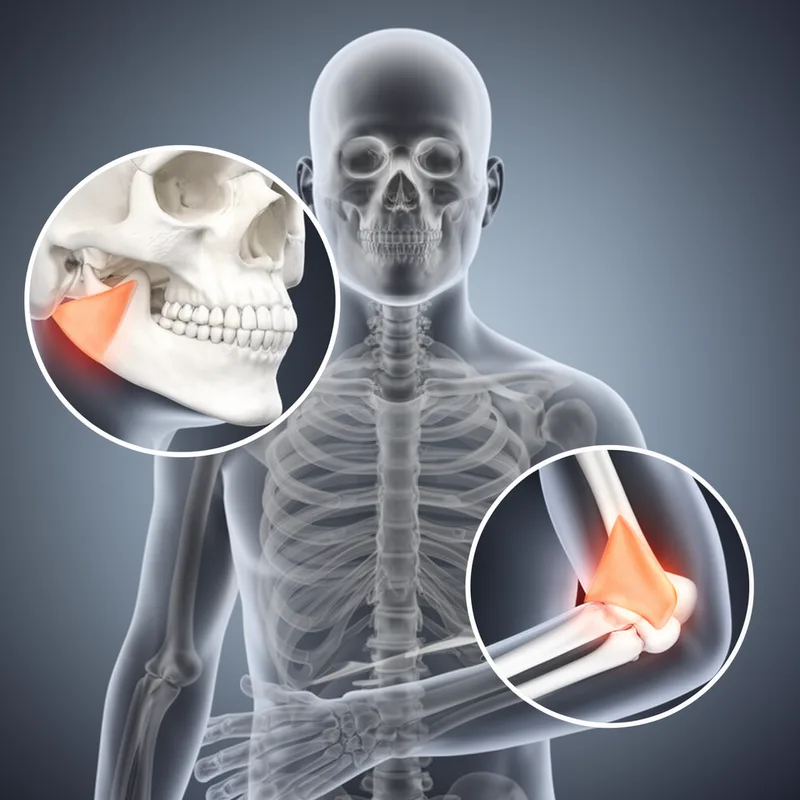
processus coronoideus
- noun
- /ˈprɒsəsəs kəˈroʊnɔɪdiəs/
- Specialized
- The processus coronoideus of the mandible serves as the attachment point for the temporalis muscle.
Examples
-
The surgeon carefully avoided the processus coronoideus during the elbow operation.
-
In some mammals, the processus coronoideus is larger to allow stronger jaw closure.
-
The processus coronoideus is crucial for jaw movement.
-
In humans, the processus coronoideus is located on the mandible.
-
The processus coronoideus serves as an attachment point for muscles in the jaw.
-
During the surgery, the doctor examined the processus coronoideus on the patient's mandible.
-
In many vertebrates, the processus coronoideus is crucial for proper jaw function.
Synonyms
A sharp triangular part that sticks out of a bone, for example the lower jaw or the ulna

A triangular bone part that sticks out from the jaw or forearm bone

A thin triangular part at the front top of the lower jaw where a chewing muscle attaches
Surface Forms
Morphology
processus + coronoideus
This is a Latin anatomical compound (processus + coronoideus). If a learner knew the constituent meanings (processus ~ process/projection; coronoideus ~ coronoid/crown‑shaped) they could infer it denotes a coronoid process (a bony projection), and similar Latin anatomical terms are cross‑linguistically recognizable. However the specialised anatomical sense of 'process' and the Latin form make the relation only partially predictable for an average B1 learner, so it is not fully transparent.
Etymology
Processus coronoideus comes from Latin: processus means 'part that sticks out' and coronoideus means 'crown-shaped', because the bone forms a small, triangular point that looks a little like a tiny crown. So, the name describes the projecting part of the jaw or the ulna and helps you remember it as a sharp bony point where muscles attach.

