

coronoid process of the mandible
- noun
- /kəˈroʊnɔɪd ˈprɑːsɛs əv ðə ˈmændɪbəl/
- Specialized
- The coronoid process of the mandible serves as a crucial attachment site for chewing muscles.
Examples
-
X-ray images revealed a fracture near the coronoid process of the mandible.
-
During the operation, the surgeon avoided damaging the coronoid process of the mandible.
-
The coronoid process of the mandible is essential for jaw movement.
-
Surgeons often examine the coronoid processes of the mandible during jaw surgery.
-
The coronoid process of the mandible provides an important attachment for the jaw muscles, enabling efficient chewing.
-
During examination, the dentist pointed out the coronoid process of the mandible as a significant feature for muscle attachment.
-
A detailed study showed that the coronoid process of the mandible plays a vital role in the functionality of the lower jaw.
Synonyms
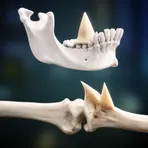
A sharp triangular part that sticks out of a bone, for example the lower jaw or the ulna
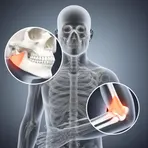
A sharp triangular bone point on the lower jaw or the forearm near the elbow

A triangular bone part that sticks out from the jaw or forearm bone
Surface Forms
Morphology
coronoid + process + of + the + mandible
The term is fully compositional: 'coronoid' (a triangular bony projection) + 'process' (a projection) + 'of the mandible' (on the lower jaw) straightforwardly yields 'a triangular bony projection on the lower jaw' as given. Though anatomical and specialized, the meaning follows regular noun-of-noun descriptive patterns used cross-linguistically in technical terminology, so a learner who knows the constituents can derive it.
Etymology
Coronoid process of the mandible may come from an old Greek word for 'crown' because the thin, triangle-shaped piece of bone on the jaw looks like a small crown or a bird's beak. A process is a part that sticks out and the mandible is the 'lower jaw', so the coronoid is the bony bit that sticks up and gives the chewing muscle a place to attach, which is why the name fits today.

