
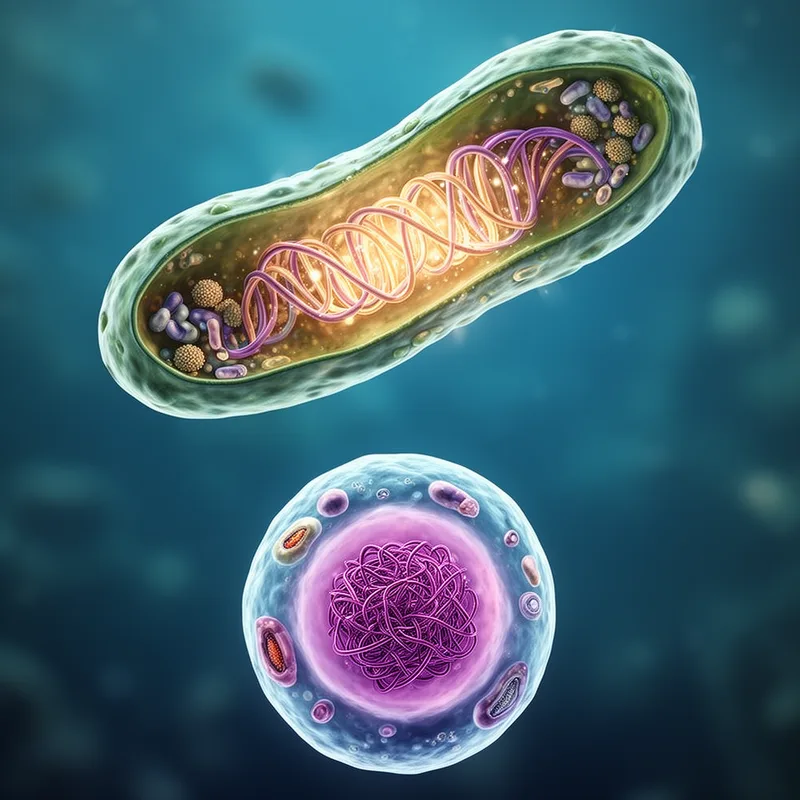
procaryotic


 1
8.5
- adjective
- /proʊˈkɛr.i.ɑː.tɪk/
- Archaic
- Researchers compared the DNA replication processes in procaryotic and eukaryotic cells.
Examples
-
The textbook explains how procaryotic cells differ structurally from eukaryotic cells.
-
Researchers compared the DNA replication processes in procaryotic and eukaryotic cells.
-
Bacteria are procaryotic organisms, meaning their cells do not have nuclei.
-
Bacteria are procaryotic organisms.
-
The procaryotic structure of these cells is fascinating.
-
Bacteria are procaryotic organisms, meaning their cells do not have nuclei.
-
The textbook explains how procaryotic cells differ structurally from eukaryotic cells.
Synonyms
 1
8.1
Having cells that do not have a nucleus or other parts covered by a membrane
Antonyms
- UK
1
8.1
Having cells with a nucleus covered by a membrane and small parts that do jobs inside the cell
Surface Forms
Morphology
procaryotic = procaryote (semi-transparent) = pro + caryot + ic
This is a standard adjective formed from the noun 'procaryote' with the suffix '-ic'.
Etymology
Procaryotic comes from the parts pro- 'before' and karyon 'kernel', like the English word 'kernel' for a small core. So procaryotic cells are 'before a nucleus', that is, they do not have a real nucleus.