
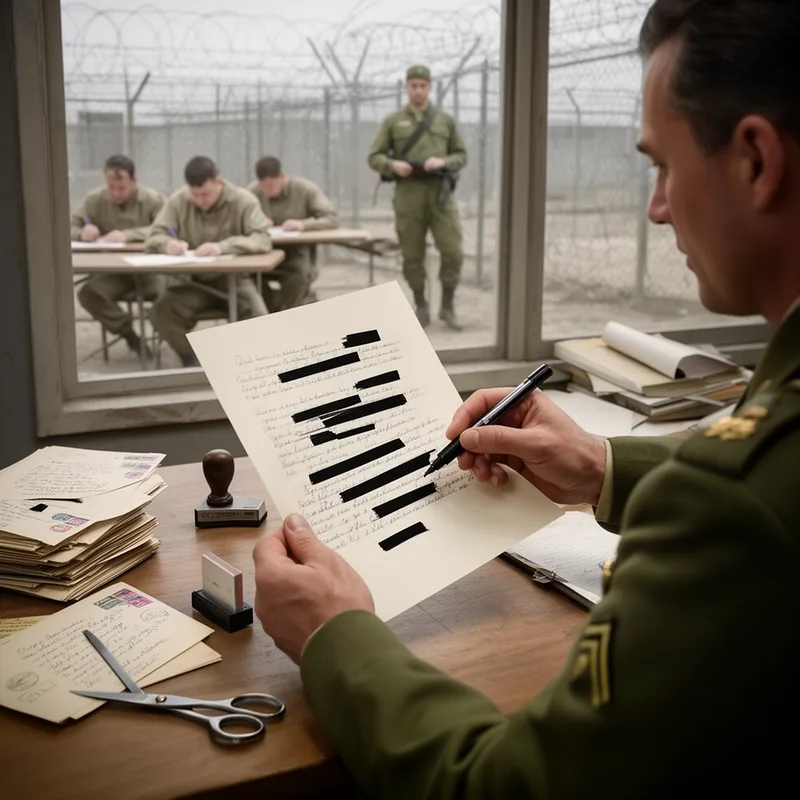
prisoner of war censorship
- noun
- Specialized
- During World War II, all letters sent by prisoners were subject to prisoner of war censorship before reaching their families.
Examples
-
Historians often study prisoner of war censorship to understand how sensitive information was controlled during conflicts.
-
The Red Cross monitored prisoner of war censorship to ensure compliance with international conventions.
-
The prisoner of war censorship policy was implemented during the conflict.
-
Many families were affected by prisoners of war censorship during World War II.
-
During World War II, all letters sent by prisoners were subject to prisoner of war censorship before reaching their families.
-
Historians often study prisoner of war censorship to understand how sensitive information was controlled during conflicts.
-
The Red Cross monitored prisoner of war censorship to ensure compliance with international conventions.
Synonyms


 1
6.1
1
6.1
People in the military check and stop news or messages to protect operations
Surface Forms
Morphology
prisoner + of + war + censorship
The phrase is directly compositional: 'prisoner of war' specifies the people concerned and 'censorship' names the practice of restricting communication, so a learner who knows those constituents can derive that it means monitoring/restricting communications of POWs. This follows standard noun + noun modification patterns found across languages and is therefore immediately interpretable by learners familiar with the component words.
Etymology
The noun prisoner of war censorship comes from the practice in war camps where guards opened and read letters sent by prisoners of war. They often cut out or blacked out words and stamped the mail as censorship, and this image of guards checking and stopping parts of messages explains why the phrase means 'watching and limiting messages to and from prisoners'.