
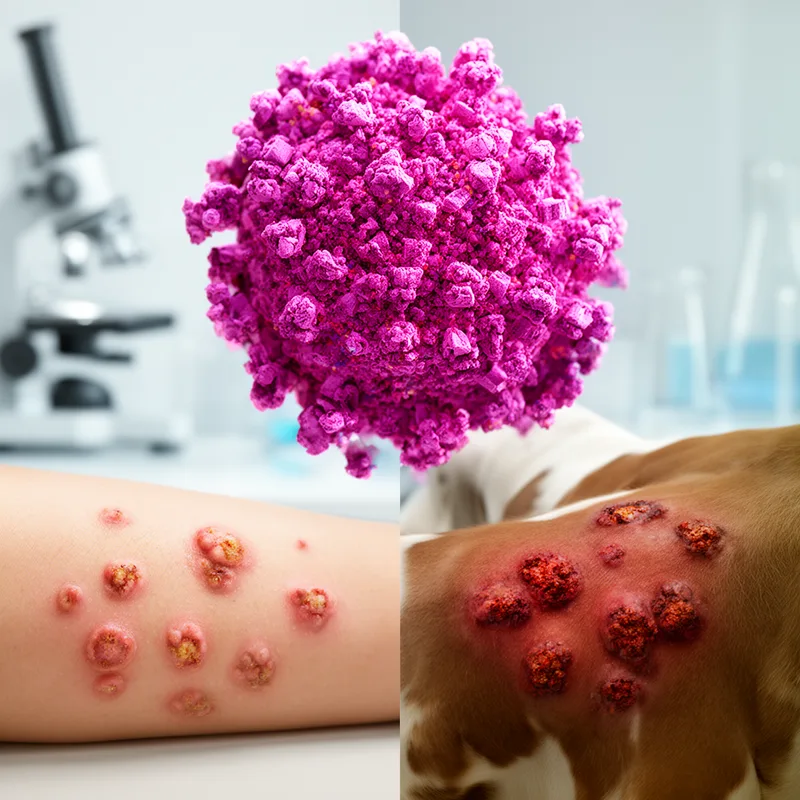
poxvirus


 1
7.4
- noun
- /ˈpɒksˌvaɪrəs/
- Specialized
- She is involved in the diagnosis and control of communicable and noncommunicable diseases, especially Rift Valley fever, poxvirus diseases, and bluetongue.
- Poxvirus Laboratory
Examples
-
There are several instances of well-preserved corpses and tissues that have been examined for poxvirus viability and viral DNA.
Academic text (2014) -
She is interested in poxvirus diagnosis and surveillance and has developed kits for detecting poxviruses.
Academic text (2013) -
We present the historical and scientific accounts of each of these specimens with their respective laboratory results, which represent published and more recent data from the CDC Poxvirus Laboratory.
Academic text (2014) -
Dr. McCollum is an epidemiologist in the Poxvirus and Rabies Branch, Centers for Disease Control and Prevention, Atlanta, Georgia.
Academic text (2014) -
Existing specimens at the CDC Poxvirus Laboratory (tissues from Egypt, Italy, and England) were reexamined using modern molecular techniques.
Academic text (2014) -
The Poxvirus Laboratory at the CDC recently reviewed this data and reexamined specimens from the inventory to revisit the existence of sections of intact DNA by using more modern methods.
Academic text (2014) -
Given that the poxvirus genomes in our study were characterized directly from clinical samples, it is plausible that this smaller range of diversity for VARV is only the result of a genetic bottleneck that occurred during cell culture isolation.
Academic text (2014) -
The research team studied the effects of poxvirus on vertebrates to better understand its transmission.
-
Vaccination campaigns have significantly reduced the incidence of diseases caused by poxvirus, such as smallpox.
-
Scientists are investigating how poxvirus can be used in gene therapy due to its ability to infect certain cells.
Synonyms
 773
3.2
A very small germ that can only live inside cells and often causes illness
 1
3.6
A virus that infects animals, not plants or bacteria
Surface Forms
Morphology
Etymology
Poxvirus comes from pox, an old English word that meant a 'sore' or 'blister' and appears in words like smallpox, and virus, the modern word for a 'tiny germ' that causes disease. So a poxvirus is a virus that makes those pox sores on the skin, as in smallpox or cowpox.