
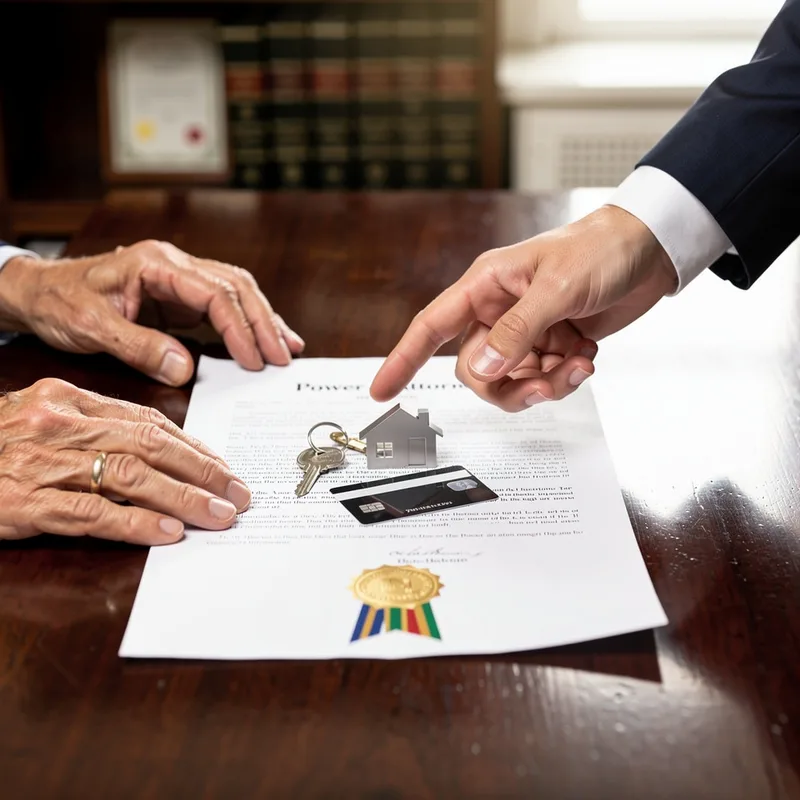
power of attorney
 23
6.0
23
6.0

- noun
- /ˈpaʊər əv əˈtɜrni/
- Formal
- Before traveling abroad, she signed a power of attorney to allow her sister to handle her finances.
- a durable power of attorney
- a medical power of attorney
- power of attorney for health care
Loading YouTube…
Watch on YouTubeYou also have your healthcare power of attorney and your living will.
- You also have your healthcare power of attorney and your living will.
- Get ready to view the power of attorney order.
- Ah, the will and the power of attorney being changed in a very suspicious way right before Carol's husband goes missing.
Examples
-
Now, Roman, my uncle gave me financial and medical power of attorney.
-
Utilize both a living will and power of attorney.
Academic text (1996) -
Do you have a copy of the power of attorney?
-
You gave me power of attorney.
-
Who has power of attorney?
-
I could give you the power of attorney.
-
You also have your healthcare power of attorney and your living will.
-
This is a power of attorney so you can sign for military dependent benefits.
-
I know you have power of attorney, but so far, you have not turned over a single solitary cent to this woman.
-
It's my grandfather's, and he gave me power of attorney.
Fiction book (2000)
Surface Forms
Morphology
The components 'power' (authority) and 'attorney' (legal representative) make the general idea — authority related to a lawyer/representative — fairly inferable to a learner who knows both words. However, the specific sense that this is a formal legal document that authorizes one person to act for another is a specialized legal meaning that may not be fully predictable without prior exposure, so it is only partially transparent.
Etymology
Power of attorney comes from old legal words: power meant the right to act and attorney was someone chosen to act for another person. So the phrase names a document that gives a person the 'power' to 'act' as your 'representative' and make decisions for you.