

to pour out of
 12
3.7
12
3.7

- phrasal verb
- /pɔr aʊt ʌv/
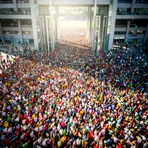
- As soon as the fire alarm went off, people poured out of the building in a hurry.
- people poured out of
- poured out of the building
- smoke pouring out of
Examples
-
The congregation pours out of the church, and parishioners run to their cars.
Fiction book (2002) -
As the fighting intensified, over six million Afghan refugees poured out of the country into Pakistan and Iran.
Academic text (1997) -
The words simply poured out of him.
-
I, I walked past hundreds of students pouring out of classrooms.
-
They'll come pouring out of the hills.
-
Now new droves of people were pouring up the streets, out of the buildings, out of the shops.
Fiction book (2000) -
They're pouring out of every printer in the office.
-
The town was unusually quiet, since almost all the soldiers had poured out of it the day before.
Fiction book (2000) -
Jeddie and Matt filed outside and waited as students poured out of the building.
Fiction book (1997) -
All the tears she hadn't cried in the past two years came pouring out of her, unstoppable.
Fiction book (1995)
Synonyms
 162
1.5
162
1.5
Many people or animals move somewhere quickly in a steady stream
 26
3.6
26
3.6
Move out of a place suddenly in large numbers or fall out of a container and spread
 18
2.9
18
2.9
Move out of a building in large numbers
Antonyms


How Many

Surface Forms
Morphology
The meaning 'to exit or emerge in large numbers' is directly and transparently derived from 'pour' (to move in a steady stream) combined with 'out' (away from the interior) plus the prepositional link 'of' indicating source; the spatial motion metaphor of liquid pouring maps clearly onto people/things leaving a place. This construction and metaphor are cross-linguistically common and follow standard English motion+particle patterns, so a B1 learner who knows the constituents can readily infer the meaning.
Etymology
Pour out of comes from the picture of liquid leaving a container. When water pours out of a jug it flows quickly and in large amounts, so people or things that 'leave quickly and in large numbers' are said to pour out of a place.