
postsynaptic
 1
7.6

- adjective
- /ˌpoʊstˈsɪnæptɪk/
- Specialized
- Stimulation intensity was far below the threshold to trigger action potentials in postsynaptic neurons; the threshold for eliciting postsynaptic spikes was consistently above 4.0 mW.
- postsynaptic receptors
- postsynaptic cell
- postsynaptic potentials
Examples
-
It can mediate the hyperpolarization of the postsynaptic membrane, induce ion influx, and decrease cell metabolism and oxygen consumption.
Academic text (2015) -
He wanted to be able to hold his own when the subject of inhibitory postsynaptic potentials arose in conversation.
Fiction book (1998) -
And that will Causeway the postsynaptic cell to change its electrical potential and and then convey a signal.
-
Postsynaptic responses were recorded at a holding potential of -70 mV.
Academic text (2017) -
In this case they can do one of two things as we'll talk about, but it all culminates in changing iron flux across the postsynaptic membrane.
-
Stimulation intensity was far below the threshold to trigger action potentials in postsynaptic neurons; the threshold for eliciting postsynaptic spikes was consistently above 4.0 mW.
Academic text (2017) -
The afferent nerve terminal appears to invaginate slightly into the outer hair cell, and there is a postsynaptic darkly stained region along the surface of the nerve fiber involved in the synapse.
Academic text (1998) -
Model neurons randomly grew their axons across the cortical sheet and stochastically formed connections with potential postsynaptic targets (similar, for example, to simulation experiments in 48 and 49).
Academic text (2018) -
Its primary action is blocking postsynaptic dopamine receptor D2 and calcium channels. It appears to be almost as effective as haloperidol but has fewer sedating side effects (Shapiro et al., 1989).
Academic text (1997) -
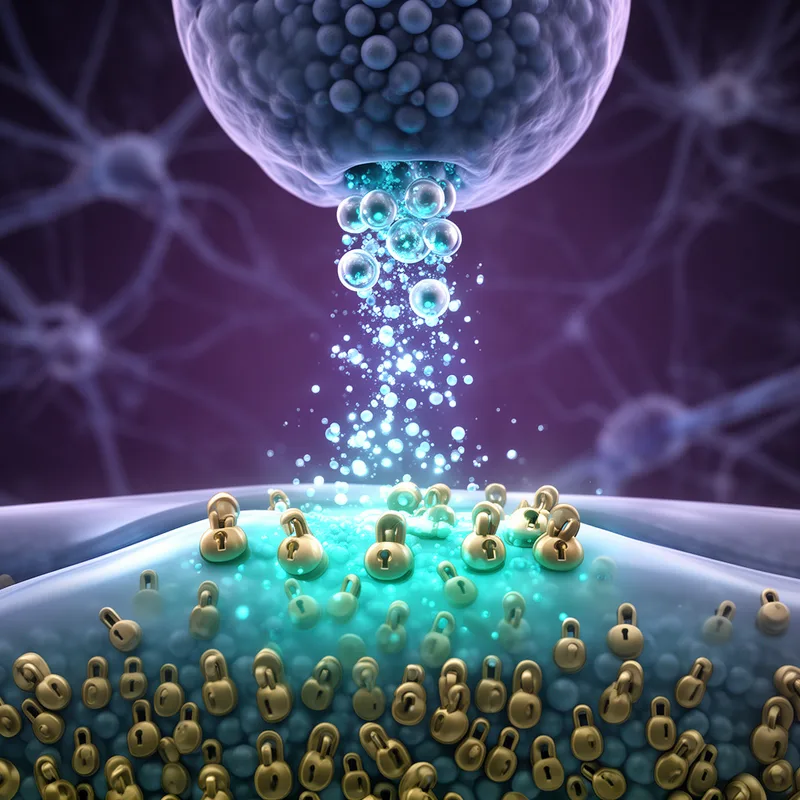
The ligand binds to the receptors on the postsynaptic membrane, leading to nerve signal transmission.
Surface Forms
Morphology
Etymology
Postsynaptic breaks into post- ('after') and synapse ('gap' between nerve cells). So, the postsynaptic part is the side 'after the gap' that receives the signal from another nerve cell.