
positronium


 1
9.9
- noun
- /ˌpɒzɪˈtroʊniəm/
- Specialized
- When positronium decays, it produces gamma rays that can be detected in particle physics experiments.
Examples
-
The system would resemble positronium, they argued, because asymptotic freedom renders the strong force between the heavy quarks Coulomb-like at distances appropriate to heavy-quark bound states.
Academic text (2004) -
In experiments, researchers observed positronium as it formed between an electron and a positron.
-
Same situation, positronium, but now at low magnetic fields.
-
A last-minute rally by the forces of organization can then lead to the formation of positronium atoms, which consist of electrons and positrons in orbit about each other.
Academic text (2000) -
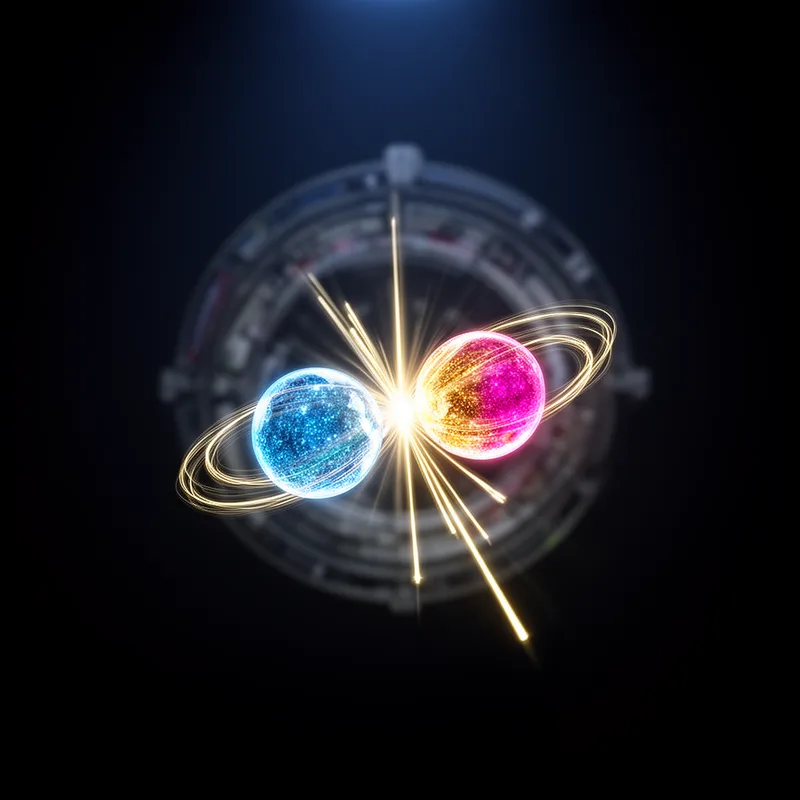
The scientist explained that positronium is an unstable atom-like system composed of an electron and its antiparticle, the positron.
Surface Forms
Morphology
Etymology
Positronium comes from positron (a 'positive' electron) plus the ending -ium you see in atom names like helium, so the word tells you it is an 'atom-like' thing made of a positron and an electron. That's why positronium refers to the short-lived, unstable system where an electron and a positron are bound together.