

positron
 9
9.3
9
9.3

- noun
- /ˈpɒzɪtrɒn/
- Specialized
- The most familiar practical application of positrons is in positron-emission tomography, called PET scanning.
- electron-positron
- positron emission tomography
- positron emission
Loading YouTube…
Watch on YouTubeThat's given by the rest mass of the electron and positron E equals MC squared.
- That's given by the rest mass of the electron and positron E equals MC squared.
- It's called positronium, happens to be an electron and a positron in orbit around each other.
- And when that happens it gives off a positron, the antimatter particle of an electron.
- The radiation that atoms can emit is of three types Alpha, that's helium nuclei, beta, that's electrons and positrons, and gamma, that's photons.
- These were really the first studies of of brain imaging using positron emission tomography long before fMRI.
- Then the excess of electrons over positrons doesn't change as the universe calls.
- In fact, electron positron Collider, LEP, now energy is conserved.
Examples
-
So you'd have perhaps an electron and a positron that both come out of this reaction.
-
But can you have positrons in any possible decay?
-
And when that happens it gives off a positron, the antimatter particle of an electron.
-
In 1936, Anderson received the Nobel Prize in Physics "for his discovery of the positron."
Academic text (2012) -
So a positive charge was retained by the emission of a positron, the antimatter version of an electron.
-
Their arrival positions and times recorded at a detector array surrounding the patient reveal the positron emission site.
Academic text (2012) -
A positron is a particle that has the same mass as an electron but carries a positive charge.
-
When a positron meets an electron, they annihilate each other, releasing energy.
-
Scientists use positrons in medical imaging techniques like positron emission tomography.
Synonyms


 1
9.9
1
9.9
A tiny particle like an electron but with a positive charge
Compounds
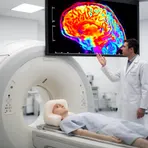
- Specialized
1
6.0
A medical scan that shows how body parts use energy, often the brain
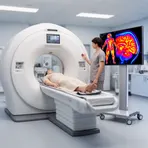
- Specialized
A machine that makes detailed pictures showing where the body uses energy
Surface Forms
Morphology
positron = positive (transparent) = posit + on
The word denotes the positively charged counterpart of an electron and is formed by 'positive' + the particle-forming suffix '-on', so the meaning is directly derivable.
Etymology
Positron comes from positive, which means 'plus' or 'positive charge', and the particle ending -on, as in electron and proton, so you can think of it as the 'positive' partner of the electron. A positron is therefore an 'electron-like' particle with a 'positive' charge, and when it meets an electron they destroy each other and release energy.