

to police
 50
3.1
50
3.1

- verb
- /pəˈliːs/
- But declining ethno-sectarian violence enables sectarianism to be policed more quickly, consistently, and harshly than in the past.
- police the border
- police behavior
- police the country
Loading YouTube…
Watch on YouTubeBut two, the way we police drugs creates monopolies.
- But two, the way we police drugs creates monopolies.
- We have to police those people.
- So the boys then start policing each other, right?
- And they are sort of self policing themselves.
- Then they've been training them up to go back to police their country.
- You're just policing up, spreading love and joy.
- And and you police, it's like it's like a family.
Examples
-
Networks differ widely in the extent to which they see it as their duty to police their electronic airwaves.
Academic text (1994) -
Advocates of better-policed borders are battling against rising volume and mounting pressure for expedited customs clearance.
Academic text (2000) -
The American government thinks it has the right to police the world.
-
I'm not out here trying to police your every life choice.
-
U.S. government troops are not trained to police their own population.
-
Governments, especially in the developing world, cannot be expected to police every archaeological site.
Academic text (2003) -
Federation soldiers began to appear and tried to police the traffic as it surged ahead.
Fiction book (1991) -
Large corporations are not the only ones that would suffer in a world of heavily policed borders.
Academic text (2000) -
Iraq's long land frontiers are difficult to police and allow easy passage into Turkey, Iran, Jordan, Saudi Arabia, and Syria.
Academic text (2003) -
The officers regularly police the neighborhood to ensure everyone feels safe.
Synonyms
 64
3.5
64
3.5
To move regularly through an area to keep it safe
Compounds




 30
7.5
30
7.5
A country where the government uses strict police control and spying to limit people's freedoms
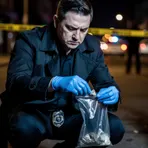

 27
6.6
27
6.6
A group that works for the government in secret to watch and punish people who oppose it
 26
2.8
26
2.8
A formal process by police to find facts and catch people who did the crime

 17
3.5
17
3.5
People in the military who make sure others follow rules, keep order, and guard prisoners


 9
3.0
9
3.0
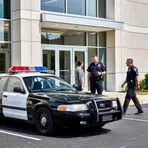
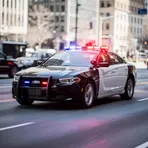
A car that police officers use for patrolling, often with lights and a siren


- Canadian
4
3.3
Canada's national police force that enforces federal laws across the country


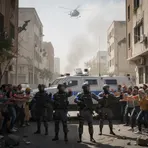

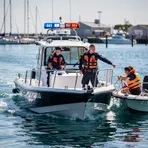
 1
4.1
1
4.1
A member of the armed forces who enforces rules, keeps soldiers in order and guards prisoners


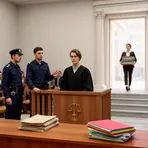
- Archaic
 1
4.6
1
4.6
A lower court that handles minor crimes and sends serious cases to a higher court


A large, intelligent dog used by police and sometimes as a guide for blind people


How Strict

Surface Forms
Etymology
The verb police means 'to keep order' or 'to guard a place' and comes from the same root as the noun police, so to police a park or street is to act like the officers who keep people safe.