
polarizability
- noun
- /ˌpoʊlərəˈzæbɪlɪti/
- Specialized
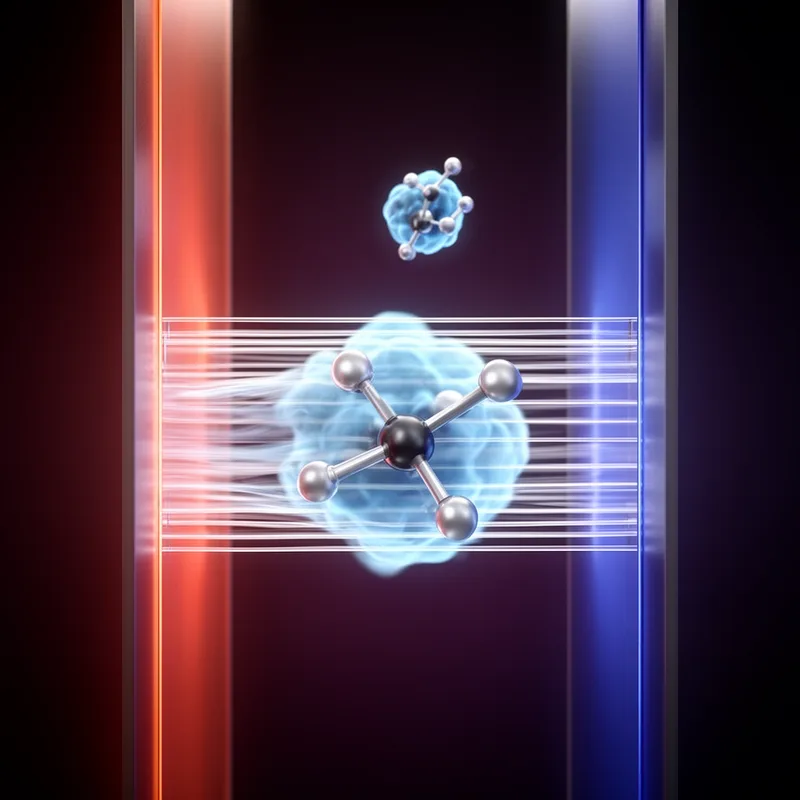
- The polarizability of molecules in an electric field affects how they interact with light.
Examples
-
Their zero electric charge, tiny magnetic moment, and small electric polarizability make neutrons relatively insensitive to environmental fluctuations that would otherwise ruin delicate measurements.
Academic text (2012) -
After all, says Strehlow, there is no known linear dependence between the magnetic field and the polarizability.
Academic text (1998) -
OK, So what, what is it that has to do with polarizability, right?
-
Do you know what the polarizability of a sphere is?
-
And it's it, it part of that must be the same reason that the the polarizability can operate within a molecule as well as between molecules.
-
Measuring the velocity of an adatom under an applied field gradient allowed us to derive the surface-induced dipole moment and polarizability of the adatoms.
Academic text (2006) -
Using expressions derived from time-dependent local density theory, Chelikowsky and his colleagues obtained excellent results for the spectra and polarizabilities of sodium and silicon clusters.
Academic text (1999) -
James Chelikowsky and his group at the University of Minnesota have beautifully exploited that advantage in determining structural properties, polarizabilities, optical energy gaps, and excitation spectra.
Academic text (1999) -
In physics, the polarizability is a key factor in understanding the behavior of atoms within an electric field.
-
Researchers study the polarizability of different materials to improve their electronic properties.
Surface Forms
Morphology
polarizability = polarizable (semi-transparent) = polar + ize + able + ity
The noun is a straightforward nominalization of 'polarizable', referring to the property of being capable of polarization.
Etymology
The word polarizability comes from polar, from words for 'pole' like North and South, plus -ize meaning 'to make' and -ability meaning 'ability to'. So, polarizability is the 'ability to be made polar', meaning how easily a molecule can get a positive and a negative side when an electric field is near.

