

poison ash
- noun
- US
- The hiker unwittingly brushed against poison ash and developed a rash the next day.
Examples
-
You should learn to identify poison ash before walking in wetland areas.
-
Botanists warn that poison ash can be mistaken for other harmless swamp plants.
-
The poison ash tree can be found near wetlands.
-
Many hikers are unaware of poison ash and its effects.
-
To avoid a painful rash, it is important to recognize poison ash in wetland areas.
-
After touching poison ash, she experienced severe skin irritation and discomfort.
-
The park ranger gave a presentation on the dangers of poison ash and how to stay safe.
Synonyms

 1
8.4
1
8.4

A North American shrub or small tree with white berries and an oil that causes a skin rash

A swamp bush with smooth branches and pale berries whose oil causes a skin rash

A shrub also called poison sumac that grows in swamps and makes an oil causing itchy skin rashes
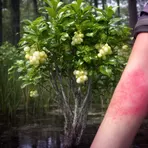
A North American swamp shrub with greenish flowers and poisonous berries and oily parts that cause skin irritation
How Toxic
- US
 15
6.0
15
6.0
Surface Forms
Morphology
The noun phrase is compositionally transparent: 'poison' modifies 'ash' to mean an ash/tree that is poisonous. A B1 learner who knows 'poison' and 'ash' can readily infer it refers to a poisonous tree/shrub (one that produces irritating oil), so the meaning is directly derivable from the constituents.
Etymology
Poison ash may come from a simple image: the shrub looks like a common ash but carries a harmful poison in its oil. That's why people call it poison ash, because touching it can give you a 'rash'.