
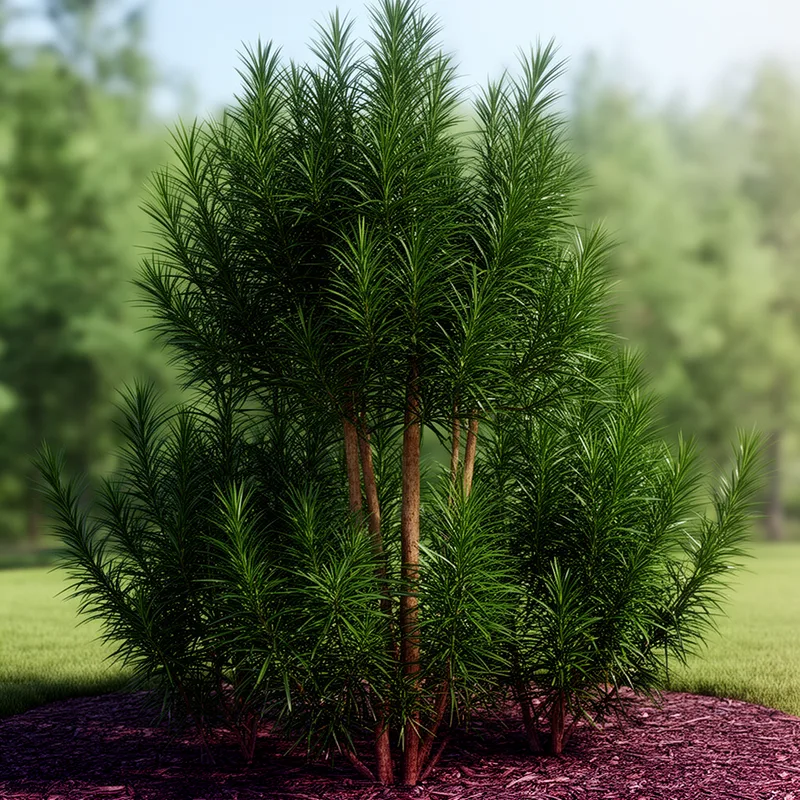
podocarpus family
- noun
- /ˌpɒdəˈkɑːrpəs ˈfæmɪli/
- Australian
- The podocarpus family includes many evergreen trees found in southern hemisphere forests.
Examples
-
Members of the podocarpus family are often used as ornamental plants in landscaping.
-
Scientists study the podocarpus family to understand gymnosperm evolution.
-
The podocarpus family includes many species of trees.
-
Many gardeners appreciate the podocarpus family for its beauty.
-
The podocarpus family is known for its unique coniferous trees that thrive in tropical and subtropical climates.
-
Many species from the podocarpus family are valued for their drought resistance and low maintenance in gardens.
-
The podocarpus family consists of a variety of species with characteristic needlelike leaves.
Synonyms

A family of evergreen trees and shrubs with small leaves like needles or scales, mostly in the Southern Hemisphere
Surface Forms
Morphology
The phrase combines a known taxonomic name (Podocarpus) with the common noun 'family', so its meaning — the family of plants related to Podocarpus (Podocarpaceae) — is directly derivable from the parts. This follows standard, cross-linguistic scientific naming/compositional patterns, making it immediately understandable to a B1 learner who knows both constituents.
Etymology
Podocarpus family comes from the plant name Podocarpus, made of the parts podo and carpus which mean 'foot' and 'fruit' because the seed sits on a small stalk like a little foot under a fruit. So the phrase names the family of those evergreen trees and shrubs.

