
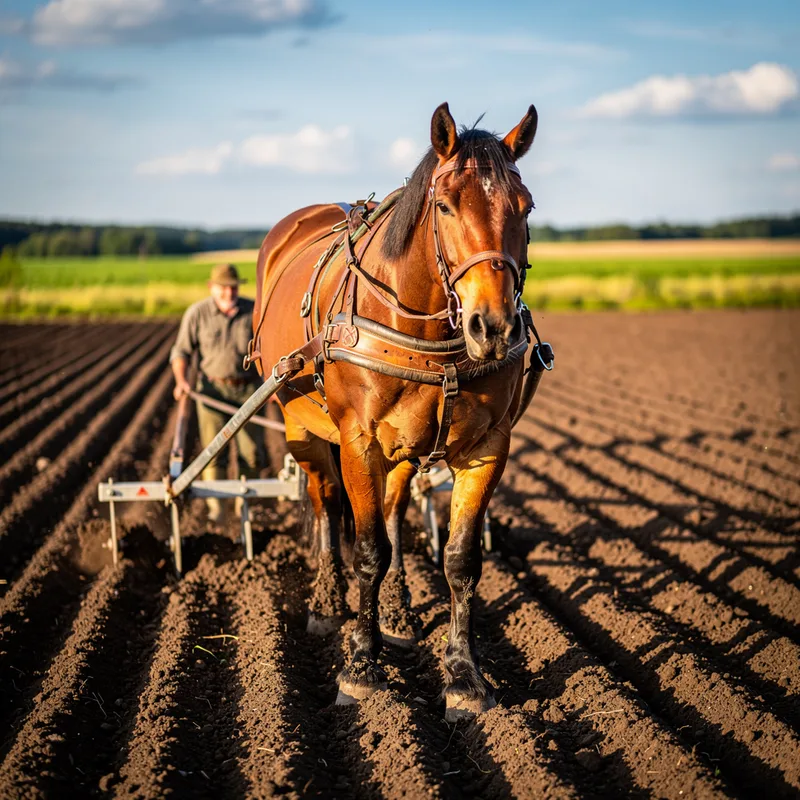
plow horse
 3
4.0
3
4.0

- noun
- /plaʊ hɔrs/
- Archaic
- See here, you're not a plow horse.
Examples
-
You were supposed to buy a plow horse!
-
My old woman was riding a plow horse in Kentucky when it come my turn.
-
I thought you needed a plow horse, Mr. Narracott.
-
Even a sturdy plow horse would never manage it alone.
-
Teams of plow horses pulled the wagons, and Yoren had bought two coursers and a half-dozen donkeys for the boys.
Fiction book (2000) -
He came plodding up to the palace of the princess on a plow horse, and he brought her a small tin box filled with mica, feldspar, and hornblende, which he had picked up on the way.
Fiction book (2000) -
The farmer relied on his strong plow horse to help him cultivate the fields each spring.
-
Every year, the community gathers to celebrate the role of the plow horse in traditional farming.
-
In the past, families used a plow horse to prepare their land for planting crops.
Synonyms
 1
3.8
1
3.8
A large strong horse that pulls heavy loads like a cart or plow
 1
3.4
1
3.4
A strong horse used to pull heavy loads on a farm
 1
3.9
1
3.9
An animal like a horse or ox that pulls heavy loads on a farm


 1
1.8
1
1.8
A strong calm horse that works on a farm
 1
3.2
1
3.2
A strong horse used to pull carts or heavy loads
 1
7.7
1
7.7
A large strong animal that pulls heavy carts or wagons
 1
9.6
1
9.6
A large strong horse used to pull heavy carts or wagons
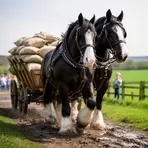
A very large strong British horse used to pull heavy loads like carts
Surface Forms
Morphology
The compound 'plow horse' is a transparent noun–noun composition: combining 'plow' (a farming implement) with 'horse' yields a horse used with a plow. This straightforward compositional pattern is common cross-linguistically and a B1 learner who knows both constituents can readily infer the meaning.
Etymology
The noun plow horse comes from the simple picture of a strong horse pulling a heavy plow across a field. These steady animals did the hard daily work on farms, so the name came to mean 'a horse used for pulling a plow'.