
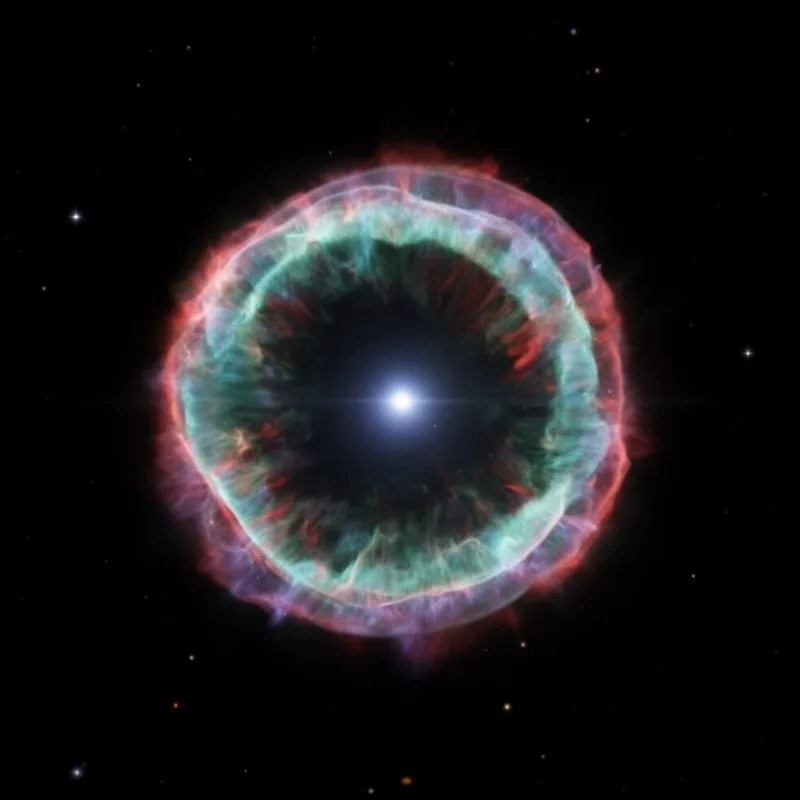
planetary nebula
 3
7.7
3
7.7

- noun
- /ˈplænɪtɛri ˈnɛbjʊlə/
- Specialized
- New Hubble images revealed intricate detail in planetary nebulae, and the Hubble Deep Field captured remote galaxies.
- planetary nebula and their stars
Examples
-
Currently, the observational search for planetary nebulae in binary star systems is one of the hottest areas of research in the field.
Academic text (1996) -
Don Snow: Could be a planetary nebula; they get their name from their green appearance.
Blog text (28) -
So we are not just the stuff of stars; we are the stuff of planetary nebulae.
Academic text (1996) -
Like all planetary nebulae, the Dumbbell formed from a star having a mass similar to that of the Sun.
Academic text (2005) -
Now we are ready to see Webb's first image of a star dying, a planetary nebula called the Southern Ring.
-
For stars about the mass of the Sun, the ejected gas forms a brilliant cloud: a "planetary nebula."
Academic text (1996) -
The resulting planetary nebula is an astronomical autopsy.
Academic text (1996) -
Now you see why Herschel misnamed them planetary nebulae.
Academic text (1996) -
The inset panel zooms in to the heart of the planetary nebula to reveal intricate details closer to the star.
Blog text (20) -
The Ring Nebula is one of the most famous examples of a planetary nebula, showcasing vibrant colors and intricate structures.
Synonyms
 29
8.2
29
8.2
A large cloud of gas and dust in space that often looks like a bright patch in the sky

A bright cloud of gas and dust in space where new stars can form
How Bright
- Specialized
3
7.7

- Specialized
- Specialized
29
8.2
- Specialized
Surface Forms
Morphology
Although 'nebula' clearly signals a cloud and 'planetary' appears to relate to planets, the established astronomical meaning is a glowing shell ejected by dying stars — not anything to do with planets. The term is a historical misnomer (named for a planet-like appearance in early telescopes), so the sense cannot be reliably derived from the constituents. A B1 learner who knows the words would likely infer an incorrect 'planet-related cloud,' making the expression non-transparent.
Etymology
Planetary nebula got its name when early astronomers looking through small telescopes saw round disks that looked like a 'planet', so they called the object planetary and used nebula to mean a 'cloud'. That's why the term now means a glowing cloud around an old star, not a real planet.