
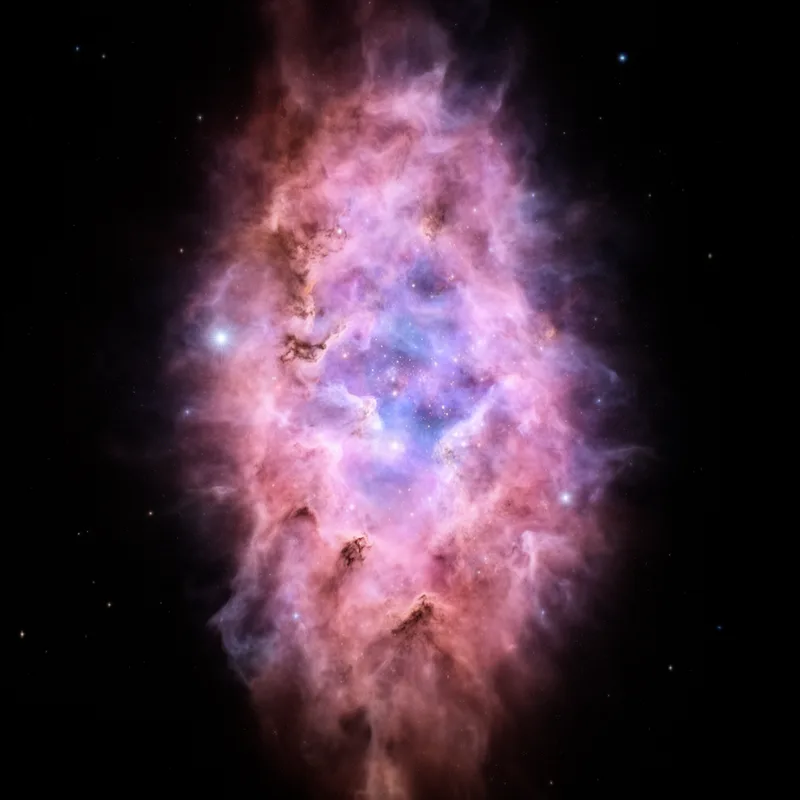
gaseous nebula
- noun
- /ˈɡeɪʃəs ˈnɛbjʊlə/
- Specialized
 :
nebulosa gaseosa
:
nebulosa gaseosa
- Probably the best turned up in 1899, when Scheiner concluded that its solar-like spectrum could only mean that the object is made up of ordinary stars, rather than being a diffuse, gaseous nebula.
- star clusters and gaseous nebulae
Examples
-
This is what astronomers see in hot gaseous nebulae known as H II regions (see bottom left image on p. 19). H II refers to ionized hydrogen gas: protons stripped of their electrons.
Academic text (1996) -
His research interests include active galactic nuclei as well as gaseous nebulae and the processes that cause them to emit and absorb radiation.
Academic text (1992) -
The 1991 award goes to Donald E. Osterbrock to recognize his contributions toward our understanding of the astrophysics of gaseous nebulae and of active galactic nuclei, the study of the history of astronomy, and the education of graduate students.
Academic text (1991) -
Astronomers often study gaseous nebulae to learn more about star formation in the universe.
-
The Orion Nebula is a famous example of a gaseous nebula that contains many young stars.
-
Images of gaseous nebulae captured by telescopes show bright colors and intricate patterns of gas and dust.
Synonyms

 29
8.2
29
8.2

A large cloud of gas and dust in space that often looks like a bright patch in the sky
A cloud of gas and dust lit by nearby stars, seen as a faint hazy patch in the sky
How Bright
- Specialized
3
7.7

- Specialized
- Specialized
29
8.2
- Specialized
Surface Forms
Morphology
The meaning is directly compositional: 'gaseous' (in a gaseous state) modifies 'nebula' (an interstellar cloud), so a learner who knows both words can infer 'a nebula made of gas'. This adjective+noun construction is a regular, cross-linguistically common pattern, making the phrase predictable and transparent to B1 learners who know the constituents.
Etymology
Gaseous nebula comes from the old word nebula, which means 'cloud', and gaseous means full of 'gas'. Astronomers used these words for the bright, glowing clouds they saw in space, so today the phrase means 'a glowing cloud of gas and dust where new stars are born'.