

pine rat
- noun
- /paɪn ræt/
- The pine rat is mostly active at night and hard to spot during the day.
Examples
-
Farmers often complain about the damage caused by the pine rat in their fields.
-
Some people try to protect their crops from the pine rat using traps.
-
The pine rat is often found in large groups.
-
Have you ever seen a pine rat in the wild?
-
Farmers often complain about the damage caused by the pine rat in their fields.
-
Some people try to protect their crops from the pine rat using traps.
-
The pine rat is mostly active at night and hard to spot during the day.
Synonyms



 1
6.7
1
6.7
A small wild animal like a rat that lives in forests, builds nests, and often collects things
 1
7.3
1
7.3
A small North American animal like a rat with a bushy tail that collects objects

A large rat-like animal with grey-brown fur that lives in forests in the southeastern United States

A small North American animal like a rat that collects things to build nests

A small animal like a mouse with a thick bushy tail that lives in western North America and stores food
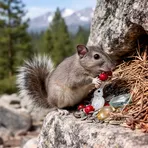
A small mouse-like animal with a thick bushy tail that lives in western North America and collects food and objects

A small animal with a bushy tail that collects and hides small things

A North American wood rat with dark feet that builds large stick nests
Surface Forms
Morphology
The meaning 'a rodent associated with pine forests' is directly and compositionally derived from 'pine' (pine trees/forest) + 'rat' (a rodent): a rat that lives in or is associated with pines. This simple noun–noun compounding pattern is common in English and cross-linguistically transparent, so a B1 learner who knows both constituents would readily infer the MWE meaning.
Etymology
The noun pine rat likely comes from a simple picture: a large rat that lives in pine trees and eats pine cones. The word pine shows its home and rat shows it is a rodent, so the name came to mean 'a large rodent found in pine forests'.