
piezoelectric effect


 1
8.8
1
8.8
- noun
- /ˌpiːeɪzoʊɪˈlɛktrɪk ɪˈfɛkt/
- Specialized
- Understanding the piezoelectric effect is essential for developing advanced pressure sensors.
Examples
-
The sensor has a silicon diaphragm using the piezoelectric effect to sense pressure.
Academic text (1994) -
"It's the piezoelectric effect," Dr. Richards said.
Fiction book (1998) -
But one thing that we'll be asking is how can we represent the variation of the piezoelectric effect with orientation of the crystal?
-
Critical dimensions in the development of sonar were experiments with the properties of sound waves in water and the discovery of the piezoelectric effect.
Academic text (2007) -
The sensor has a silicon diaphragm that utilizes the piezoelectric effect to measure pressure changes.
-
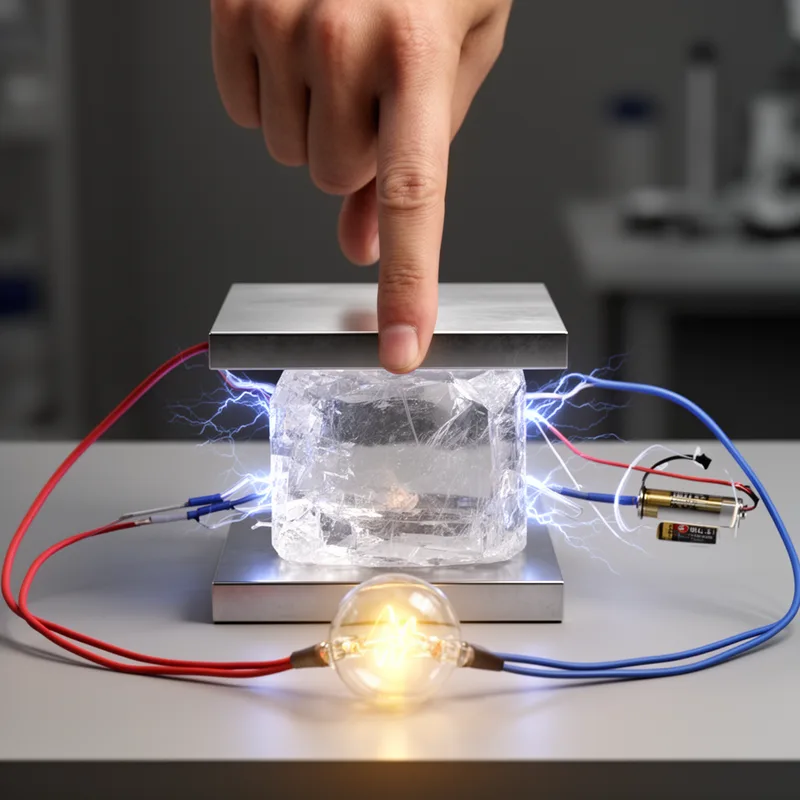
The piezoelectric effect allows certain materials to generate an electric charge when they are compressed.
Synonyms

An electric charge some crystals like quartz make when pressed or their change in shape when given electricity

Crystals make electricity when squeezed or when an electric field makes them change shape
Surface Forms
Morphology
The compound is fully compositional: 'piezoelectric' names the property (generation of electric charge under mechanical stress) and 'effect' signals the phenomenon resulting from that property, so the meaning is directly derived from the constituents. This adjectival + noun pattern is standard and mirrored in many languages, making the phrase predictable for a learner who knows both words.
Etymology
Piezoelectric effect comes from the Greek root piezo meaning 'to press' plus electric, so imagine squeezing a small crystal and getting a tiny spark. That's why the phrase means 'making an electric charge when a crystal is squeezed', and it also explains why applying electricity can make the crystal change shape.