

phytophage
- noun
- /ˈfaɪtəˌfeɪdʒ/
- Specialized
- The caterpillar is a common phytophage that primarily feeds on the leaves of plants.
Examples
-
If higher species loading translates to higher average phytophage occupation, this could make it more difficult for a North American invader to colonize European trees.
Academic text (1996) -
Nor have there been comparative studies of the inherent defenses of American and European phytophages against their respective predators and parasites.
Academic text (1996) -
This supports the contention that phytophage establishment in a new environment depends on an abundance of ancestral (congeneric, confamilial) host material.
Academic text (1996) -
More significantly, if higher insect species loading led to more intense competition in the evolutionary past of European phytophages, then these insects might be more adept than equivalent North American species at exploiting their essential resources and hence at invading.
Academic text (1996) -
As a phytophage, the grasshopper plays a crucial role in the ecosystem by consuming various types of vegetation.
-
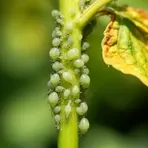
Many species of phytophages, like aphids, are known to damage crops by feeding on plant sap.
Synonyms
 14
5.6
14
5.6

A small insect that sucks sap from plants and often damages them

A small insect like an aphid that sucks juices from plants

A small insect that feeds on plants and often damages crops
Antonyms

How Plant-Eating

Surface Forms
Morphology
phytophage = phyto + phage (semi-transparent) = phyto + phage
Morphologically regular 'plant' + 'eater' formation using Greek combining forms; clear to those familiar with scientific morphemes but likely unfamiliar to average B1 learners.
Etymology
Phytophage comes from the Greek parts phyto- ('plant') and -phage ('to eat'), so it literally means 'plant-eater' and refers to animals or insects that feed mainly on plants.