
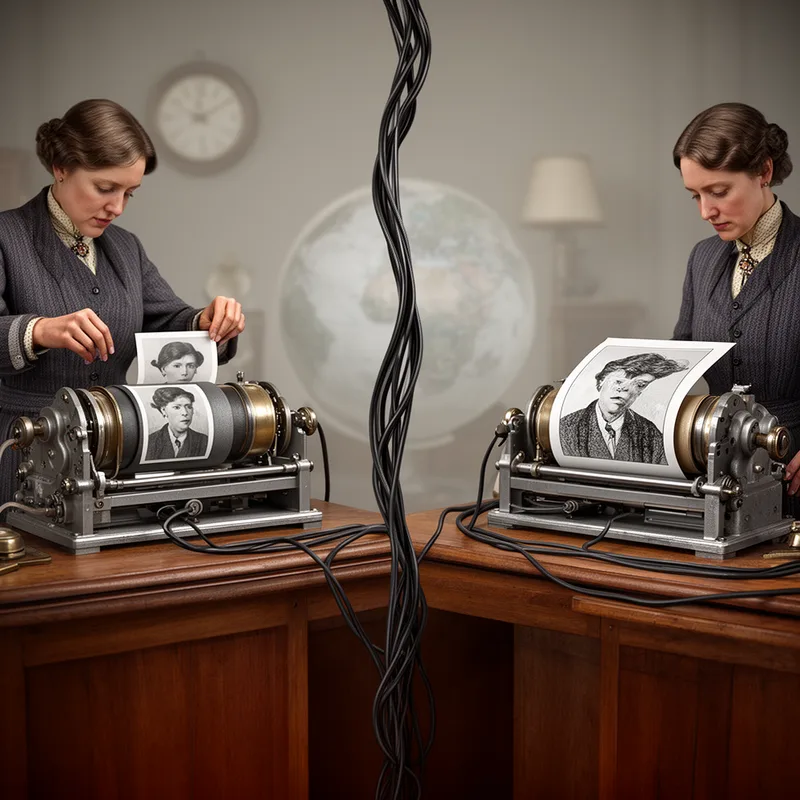
phototelegraphy
- noun
- /ˌfoʊtəʊtɛlɪˈɡræfi/
- Archaic
- Scientists in the early 20th century made significant advances in phototelegraphy for newspaper photo transmission.
Examples
-
The museum has an exhibit showcasing the evolution of phototelegraphy and early fax machines.
-
In the 19th century, phototelegraphy was considered cutting-edge technology.
-
Before email and digital scanners, phototelegraphy was used to send images across continents.
-
The invention of phototelegraphy revolutionized communication.
-
Before email and digital scanners, phototelegraphy was used to send images across continents.
-
In the 19th century, phototelegraphy played a crucial role in the rapid sharing of news through images.
-
The museum has an exhibit showcasing the history of phototelegraphy and its influence on modern facsimile technology.
Synonyms
Sending photos over wires or radio to another place

To send photos by radio
Surface Forms
Morphology
phototelegraphy = telegraphy (semi-transparent) = photo + tele + graph + y
Adding photo- to telegraphy gives a recognizable but specialized meaning: transmission of images over distance.
Etymology
Phototelegraphy joins photo, meaning 'light' and used for 'picture', with telegraph, from tele- 'far' and -graph 'write', meaning 'writing far away'. So phototelegraphy means 'sending pictures far away' and was an early way to send photos by electrical signals, a forerunner of the fax.

