

phase modulation


 1
6.6
1
6.6
- noun
- /feɪz ˌmɒdʒʊˈleɪʃən/
- Specialized
- Engineers often utilize phase modulation to improve the efficiency and clarity of wireless communications.
- self-phase modulation
Examples
-
In radio transmission, phase modulation allows for the transfer of information by altering the phase angle of the carrier wave.
-
That self-phase modulation across the temporal pulse generates the new frequency components.
Academic text (2012) -
The rich physics of the supercontinuum really arises from the interaction between the nonlinear effect of self-phase modulation and the linear dispersion.
Academic text (2012) -
With them, the interactions of self-phase modulation and dispersion produce structures whose shape and spectra evolve periodically with time and distance, as shown in figure 3.
Academic text (2012) -
Because light is guided over long distances within a small cross-sectional area, effects such as self-phase modulation can be observed at much lower power in fiber than in bulk materials and can accumulate with propagation distance.
Academic text (2012) -
Self-phase modulation occurs when light is focused into any dielectric material, but the effects of diffraction in a bulk medium always limit the distance over which light is intense enough to stimulate nonlinear frequency generation.
Academic text (2012) -
Phase modulation is a technique used in telecommunications to transmit data by changing the phase of the signal.
Synonyms
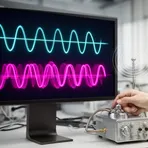
A way of changing a radio signal by shifting its wave phase
How Complex
- Specialized
1
6.6

- Specialized
10
6.1
- Specialized
- Specialized
2
7.2
1
4.3
Surface Forms
Morphology
The term is compositional: it names the type of modulation that varies the 'phase' of a carrier signal, so knowing 'phase' and 'modulation' allows one to infer it is modulation done by changing phase. Although technical, this is a standard scientific compound and follows transparent naming patterns common across languages, so a learner familiar with the constituents would understand the meaning.
Etymology
Phase modulation comes from the simple picture of a steady wave where you move its peaks a little forward or backward. Here phase means the wave's position and modulation means 'changing', so using these small shifts to carry signals is why the phrase means 'sending information by changing the wave's phase'.