
modulation
 3
6.6
3
6.6

- noun
- /ˌmɒdʒʊˈleɪʃən/
- Specialized
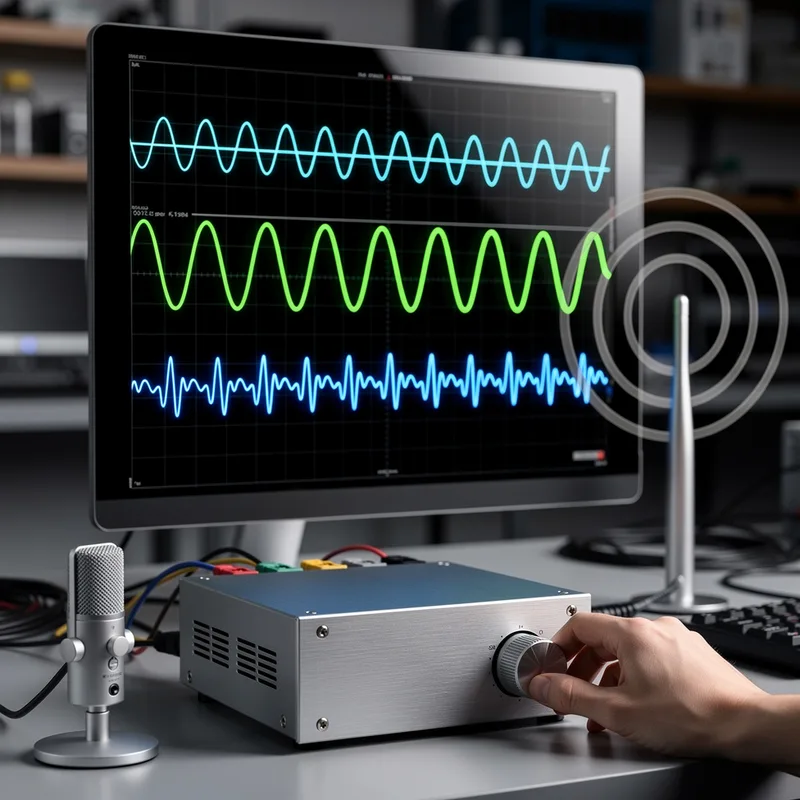
- In telecommunications, modulation is essential for efficiently transmitting information over various media.
- amplitude modulation
- frequency modulation
- phase modulation
Examples
-
The use of several small engines allows thrust modulation to replace the control surfaces in the tail and rudder.
Academic text (2001) -
One is the new model with the neo-pulse frequency modulation system.
-
The mixing resembles the frequency modulation done by commercial radio stations.
Academic text (1996) -
In the previous section, the amplitude-modulation capability of the modulator was described.
Academic text (1997) -
Another responsibility of the laser driver is to supply a high-frequency modulation (HFM) current to the laser.
Academic text (1996) -
Thus, AOMs have amplitude-modulation characteristics suitable for PQE when they are driven by appropriate AOM drivers.
Academic text (1997) -
Optical disks use run-length-limited (RLL) modulation codes such as 0, 3 and 2, 7 to improve detection.
Academic text (1996) -
Using frequency modulation, the radio station broadcasts its signal clearly across long distances.
-
Modulation allows for the adaptation of the carrier wave's properties to ensure that the transmitted signal is clear.
Antonyms
Compounds


- Specialized
 1
6.6
1
6.6
A way of sending information by changing the timing of a radio wave

- Specialized
A way of sending sound by changing how fast a radio wave vibrates

- Specialized
A way of changing a series of pulses, for example their length or strength, to send information
- Specialized
A way of sending information by changing the time between short signals
How Modulated

Surface Forms
Morphology
Etymology
Modulation comes from Latin modus 'measure' and modulus 'small measure', which gives the image of changing a wave in small ways so it can carry a message. That's why in electronics modulation means altering a signal so it can send sound or information over the air or wires.