
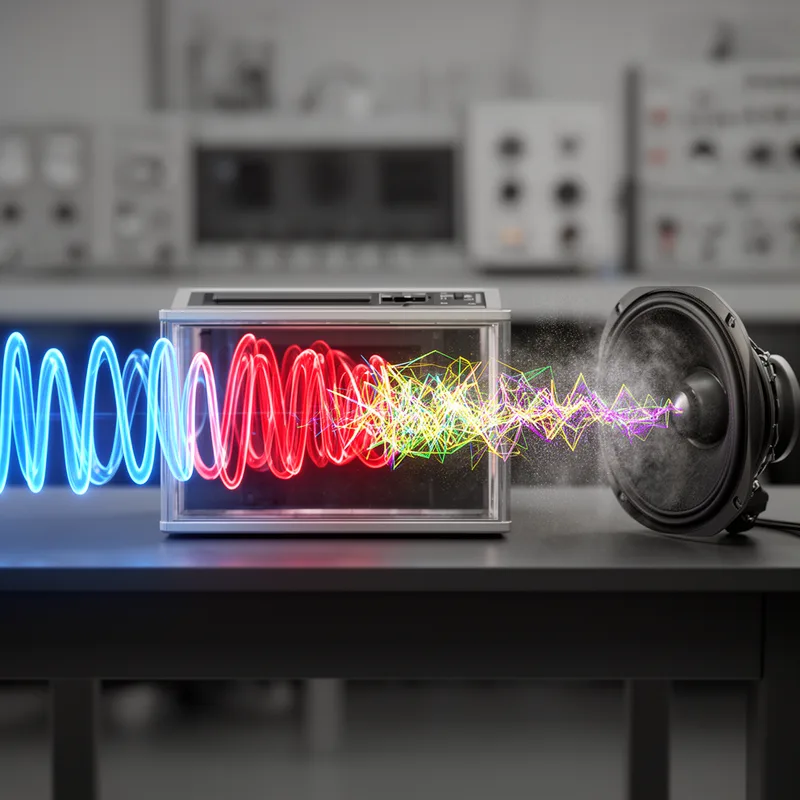
intermodulation
- noun
- /ˌɪntərˌmoʊdʒʊˈleɪʃən/
- Specialized
- The engineer explained that intermodulation occurs when two signals interact, creating new frequencies that were not in the original signals.
Examples
-
The compression processing results in a small amount of intermodulation distortion, typically about 1 to 2 percent, but this level of distortion is substantially lower than the results of amplifier saturation for the same input level and clipping threshold.
Academic text (1990) -
There are also impurities these metrics can't catch, such as noise and intermodulation distortion, and even when they do highlight a difference, they won't tell us what caused it.
Blog text (4) -
Intermodulation distortion
Academic text (1990) -
In audio systems, intermodulation can degrade sound quality by producing frequencies that were not intended in the original music.
-
Understanding intermodulation is crucial for designing communication systems that require clear transmission without interference.
How Distorted
- Specialized

- Specialized
Surface Forms
Morphology
intermodulation = modulation (semi-transparent) = inter + modulation
The formation inter- + modulation is morphologically regular, but the precise technical meaning (mixing of signals producing new frequencies) is specialized and may not be inferable to average learners.
Etymology
The word intermodulation comes from inter- meaning 'between' and modulation meaning 'a change in a signal', as with a modem that changes data signals. So intermodulation is when two or more signals meet and change each other, making new, often unwanted, tones or frequencies.

