
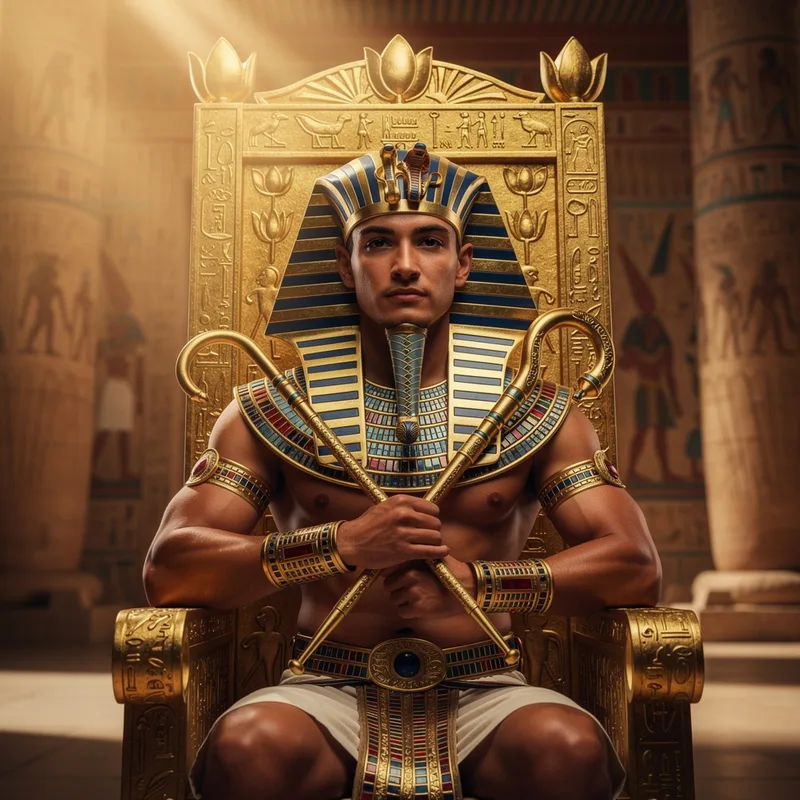
pharaoh
 48
7.7
48
7.7

- noun
- /ˈfɛəroʊ/
- The pharaoh ruled over ancient Egypt as both a political and religious leader.
- Egyptian pharaohs
- pharaohs and queens
- become pharaoh
Loading YouTube…
Watch on YouTubeWhy statues of female pharaoh Hachepsit came with a fake beard.
- Why statues of female pharaoh Hachepsit came with a fake beard.
- I think that had a lot to do with playing a pharaoh and me being Egyptian.
- He was God and on earth, right, the Pharaoh.
- Now he was unsure about Sammis as the name of the pharaoh buried in the tomb.
- It's widely accepted that it's a lion's body with a Pharaoh head.
- What did the magicians of Pharaoh do?
- All I'm saying is queen is like, that's like saying that the president is a pharaoh.
- You look to that what you will discover is as mysterious as Joseph trying to interpret the dreams of Pharaoh.
- Well, you know how they used to make a king in, in, in the old world, You know, the world of Pharaohs?
- And they dig up tombs, the Pharaohs and fine honey.
- It's a bit like a hieroglyphics from Pharaohs.
Examples
-
We know who built the Great Pyramid: the pharaoh Khufu, who ruled Egypt about 2547-2524 B.C.
Academic text (2007) -
OK, Who was the last pharaoh of Egypt?
-
For now, it is enough that the mummy, probably a pharaoh, will go home.
Academic text (2003) -
All the official records would be sealed under the weight of time, like a pharaoh in his tomb.
Fiction book (1997) -
Did you know that the wives of dead pharaohs were buried alive with them?
-
I dreamt of the great pharaohs of history.
-
Curator: He was the richest of all the pharaohs of ancient Egypt.
Fiction book (1999) -
The legitimate heir was Prince Ramesses, son of Iset, one of the pharaoh's two principal wives.
Academic text (2006) -
Many ancient monuments were built in honor of the pharaoh during their reign.
-
The pharaohs of Egypt were often buried in elaborate tombs filled with treasures.
Synonyms


Compounds

- Specialized
A small yellowish-red ant that often lives in houses and is hard to get rid of
Surface Forms
Etymology
Pharaoh comes from old Egyptian words per-aa meaning 'great house', the name for the royal palace; people then used the palace name for the royal family. So, pharaoh became the title for the king, the political and religious ruler of ancient Egypt.