

peatland
 1
5.8
1
5.8

- noun
- /ˈpiːtˌlænd/
- Even in peatland ecosystems, root channels can create discontinuities in the soil profile.
- Tropical peatlands
Loading YouTube…
Watch on YouTubeNow peatlands and this type of wetland is not specific to Canada.
- Now peatlands and this type of wetland is not specific to Canada.
Examples
-
Each year, around 20 grams of carbon are absorbed by every square meter of peatland.
Blog text (5) -
Most peatlands are found in temperate areas north and south of the 45th parallel.
Blog text (13) -
But then, Andy, what happens if a peatland dries out?
-
These peatlands store as much carbon as all the world's other forests combined.
-
Its regional topography and resources are varied, as is its agriculture-based economy; and there is a large peatland area to the west.
Academic text (1999) -
And again, as with forests and with peatlands and wetlands, this is a natural way to store carbon.
-
"Our calculations show that the peatlands could contribute towards global cooling equivalent to five watts per square meter.
Blog text (5) -
Given the large areas of damaged but not totally destroyed peatlands in the region, there is also an urgent need for research into the possibilities for restoration.
Academic text (2011) -
Positive feedback loops among deforestation, drainage, and fire mean that peatlands are easily degraded once the balance is upset.
Academic text (2011) -
In the Amazon rainforest, peatlands are vital for maintaining biodiversity and storing carbon.
Synonyms
 68
3.5
68
3.5
An area of land that is always or sometimes wet and has water plants and animals
 33
4.9
33
4.9
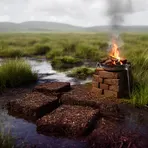
A wet, soft area of ground with dead plants
 1
6.3
1
6.3
A wet, spongy area of land made of dead plants used as fuel
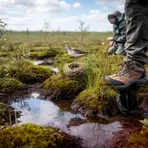
Wet, spongy land with moss and peat where plants and animals live
How Peaty

Surface Forms
Morphology
Etymology
The word peatland breaks into peat and land, where peat is 'partly rotted plants' that build up in wet places and land means 'ground'. So a peatland is an area of ground with a thick layer of peat, soft and often wet like a bog.