
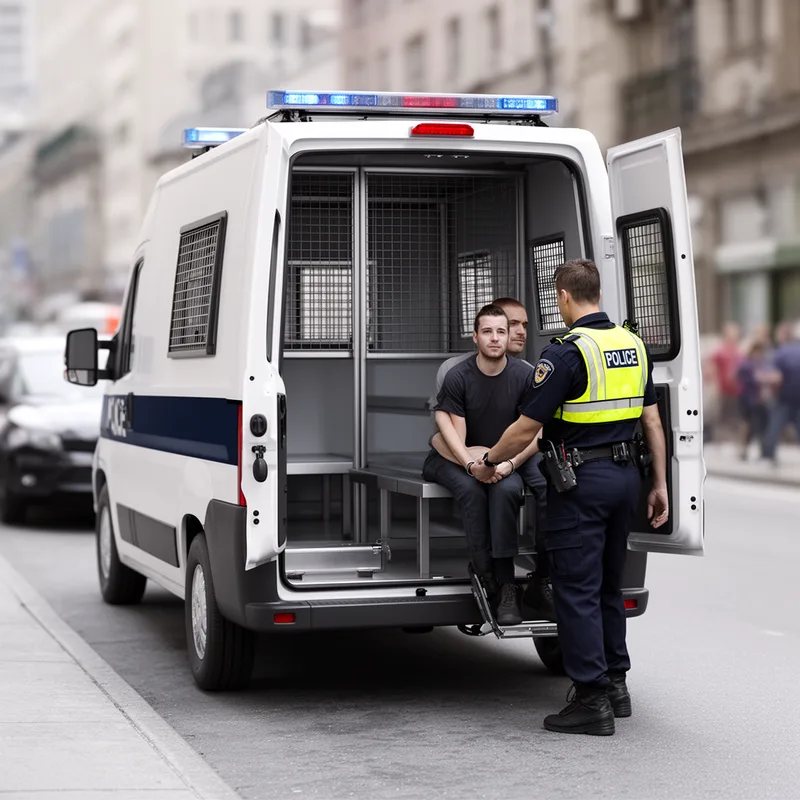
patrol wagon
- noun
- /pəˈtroʊl ˈwæɡən/
- US
- Take a patrol wagon and scour the whole section.
Examples
-
Did you tell him to call out the patrol wagon?
-
The police arrived in a patrol wagon to transport the suspect to the station.
-
After the arrest, the officers placed the criminal in the back of their patrol wagon.
-
The patrol wagon drove quietly through the neighborhood, ready for any emergencies.
Synonyms

 37
5.9
37
5.9

A van used by police to carry prisoners to a station
 5
8.2
5
8.2
A police van that carries prisoners
 5
1.6
5
1.6
A van police use to carry people they have arrested
 1
3.3
1
3.3
A van police use to carry people they arrest

A police van used to carry prisoners
Surface Forms
Morphology
The meaning 'a van used by police to transport prisoners' is directly and transparently derived from combining 'patrol' (a police unit/activity) with 'wagon' (a vehicle), so a learner who knows both words can infer it denotes a police vehicle. This noun–noun composition is a common, compositional pattern (compare 'police van', 'patrol car') and has clear cross-linguistic parallels, making it accessible to a B1 learner.
Etymology
The name patrol wagon comes from the old image of police on patrol using a horse-drawn wagon to carry people they had arrested. That's why today patrol wagon means 'a van used by police to transport prisoners'.